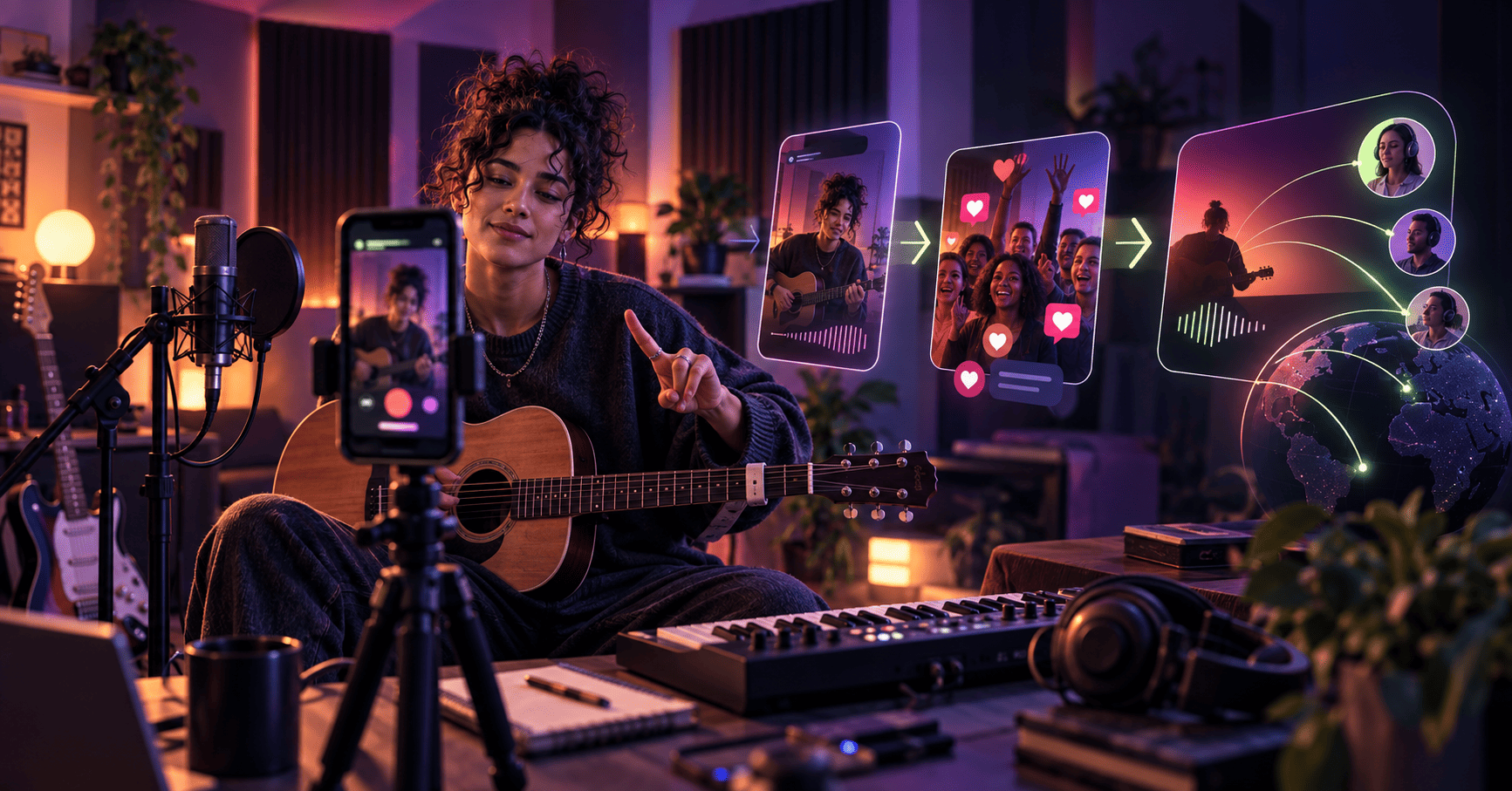
Strategies, content formats and benchmarks that help music accounts grow a real, engaged Instagram audience.
Instagram can introduce your music to someone in seconds. The harder part is giving that person a reason to stop, listen, remember your name, and come back. This guide shows independent musicians, bands, DJs, and producers how to build an Instagram strategy around those four actions.
By
Marie Weber
· Strategic Content Partner and Author at JamFeed
Published:
August 31, 2026
· Updated:
September 15, 2026
Key takeaways
Use Reels to reach new listeners, then use Stories, DMs, Lives,
and broadcast channels to build a stronger connection.
Give each post one job: introduce the artist, promote a release,
deepen fan engagement, sell tickets, or drive listeners to the music.
Make the artist name, genre, current release, and next action clear
within a few seconds of someone opening the profile.
Build several content ideas around each song instead of relying on
a single release announcement.
Measure watch time, shares, profile visits, link activity, and
streaming results—not only likes and follower growth.
The short answer: how should musicians use Instagram?
Musicians should use Instagram as a path from discovery to connection, not as a digital bulletin board. Reels can put a song or story in front of new people. Carousels and feed posts can give that music context. Stories, DMs, Lives, and broadcast channels can turn casual viewers into familiar faces. A clear profile and release link then help interested fans take the next step.
The strongest strategy is simple enough to repeat: show the music, show the person or process behind it, invite a response, and measure what happens after the view. You do not need to post every day. You need a recognizable idea and enough consistency to learn what your audience actually wants.
A viral Reel is not the finish line. For a musician, the better question is: did the right people hear the song and want more?
Start with one music goal, not a posting schedule
Most Instagram plans start in the wrong place. They begin with a calendar: three Reels, two Stories, one carousel. That looks organized, but it does not answer the most important question. What should the audience do after seeing the content?
Choose one primary goal for the next four to six weeks. It could be:
introducing your artist identity to new listeners;
building anticipation for a single, EP, or album;
getting more people to save, stream, or pre-save a release;
selling tickets for one show or a tour;
growing a local fan base;
finding collaborators, press, or industry contacts;
reconnecting with existing fans between releases.
Your goal changes the content. A new artist needs repeated introductions, memorable song clips, and a clear point of view. An artist two weeks from a release needs a narrative that creates curiosity. A touring band needs city-specific proof, live energy, dates, and an easy route to tickets.
If every post is trying to grow followers, promote a song, sell tickets, explain your story, and impress the industry at once, the message becomes weak. Give each piece of content one job.
Build an Instagram profile that makes sense in five seconds
Imagine someone discovers a Reel without knowing you. They like the sound, tap your name, and land on your profile. You now have a few seconds to answer three questions: Who is this? What kind of music do they make? What should I do next?
Choose a professional account
A creator or business account gives you access to professional tools and Instagram Insights. For most independent artists who are building a personal brand, a creator account is a natural starting point. A label, venue, or music company may prefer a business account. Review the available features and music licensing options before choosing, because access can vary by account type and region.
Make your name searchable
Use the artist or band name people will type into search. If the handle is not exact, keep the display name clear and consistent with Spotify, YouTube, TikTok, your website, and press coverage. Avoid decorative spelling that makes a new listener guess who you are.
Write a bio with useful context
A musician bio does not need a stack of vague adjectives. Give people something specific. Name the genre or scene, add a concrete identity cue, and point to the current action.
Weak: Artist. Dreamer. New music soon.
Stronger: Alt-pop made in Chicago. New single “After Midnight” out September 18. Hear the preview below.
Use the link as a changing campaign asset
Your profile link should match the campaign you are running now. Before a release, it may lead to a pre-save page. On release day, it may open a smart link with major streaming services. Before a show, it may lead directly to tickets. Do not send every visitor to a generic homepage and make them hunt for the next step.
Pin posts that orient a new visitor
Your pinned posts can work like a short artist introduction. A practical set is:
your strongest performance or song clip;
a post that explains who you are and what you sound like;
the current release, tour, or most important next action.
Organize Highlights around fan questions
Use Highlights for information that stays useful after a Story disappears: Music, Live, Studio, Tour, Press, About, and Fan Posts. Keep the labels short. The goal is not to archive every Story. It is to help a new listener understand your world.
Use a content system built for music
“Post consistently” is incomplete advice. Consistency only helps when people begin to recognize what you make. A better system uses a few repeatable content pillars, each showing a different reason to care about the artist.
1. The music
Lead with the thing people came for. Share live takes, stripped versions, alternate intros, unreleased demos, production breakdowns, covers, rehearsals, and the strongest moment from a finished track. One song can produce many pieces of content when each version creates a new listening experience.
2. The story
Explain what a lyric means, why the song changed, what nearly got cut, or where the idea started. Context can make a short audio clip feel personal. The story does not need to be dramatic. Specific details are often more memorable than big claims.
3. The process
Let people see the work: writing, recording, sound design, band practice, vocal warmups, gear choices, visual planning, or the messy middle of a release. Process content gives fans a reason to follow before the final product arrives.
4. The person or band
People can like a song and still forget the artist. Show enough personality that your music has a human anchor. Talk about influences, routines, small wins, creative doubts, tour moments, or the culture around your scene. Share what fits your boundaries; authenticity does not require publishing your entire private life.
5. The community
Feature fan videos, answer questions, respond to comments, celebrate collaborators, recommend another artist, or invite people to choose between two versions. Community content changes the account from “watch me promote” to “this is something we are part of.”
6. The offer
Ask for the stream, pre-save, ticket sale, email signup, merch order, or playlist add. Promotional posts are not a problem. Uninterrupted promotion is. A useful account earns attention between asks and makes the ask clear when it matters.
Give each Instagram format a specific job
You do not need to use every Instagram feature every day. Think of each format as a different room in the same venue.
How musicians can use each Instagram format
Format
Best job
Music content examples
Useful signals
Reels
Discovery
Song hooks, live clips, demos, transformations, performance concepts
Watch time, replays, shares, profile visits
Stories
Daily connection
Studio updates, polls, countdowns, backstage moments, links
Replies, sticker taps, link taps, completion
Carousels
Context and saves
Lyric stories, tour diaries, release breakdowns, lessons learned
Saves, shares, comments, profile visits
Feed photos
Identity and proof
Artwork, press, show photography, campaign visuals
Shares, profile actions, comments
Live
Real-time depth
Mini sets, Q&As, listening sessions, collaborator conversations
Peak viewers, comments, watch duration
Broadcast channels
Direct updates
First listens, voice notes, polls, ticket reminders, studio news
Reactions, poll responses, link activity
Instagram also offers tools such as Collabs, reposts, trial Reels, interactive stickers, and professional insights. Availability can change by account and region, so check Instagram’s own Best Practices section in the professional dashboard before building a campaign around one feature.
Create Reels that make people hear the song
Musicians sometimes treat Reels as tiny advertisements. The artist points to “new song out now,” the track plays underneath, and the clip ends. That can work for existing fans. It gives a stranger very little reason to care.
A discovery Reel needs an immediate promise. The first moment should create tension, curiosity, emotion, or recognition. Then the video should deliver quickly.
Try hooks like:
“I wrote this chorus after getting the same 2 a.m. text for the third time.”
“What if a 1990s R&B song was produced as dark pop?”
“The label said the intro was too strange. We kept it.”
“Which version belongs on the record: A or B?”
“This is what 40 voices sound like in my apartment.”
Put the strongest visual or musical moment near the beginning. Add on-screen text when it helps people understand the setup without sound, but do not cover the performance with a paragraph. Use a caption to add context, name the song, and invite one relevant response.
Most importantly, test multiple creative ideas for the same music. Change the opening line, camera angle, story, or section of the song. Do not assume the track failed because one video did. Instagram’s trial Reels can also let eligible creators show a Reel to non-followers first and evaluate the response before sharing it more broadly.
Should musicians use trending audio or their own music in Instagram Reels?
Use your own recording when the Reel's job is to help a new listener remember your song. A performance clip, a strong chorus, an alternate version, or a short story behind a lyric should lead people toward the music you release.
Use trending audio when the post has a different job: showing backstage life, introducing the band, sharing a tour moment, or joining a format that fits your personality. A popular sound may help frame the video, but it will not teach viewers what your own music sounds like.
Your goal
Audio to try first
What to check afterward
Introduce a song
Your own track or live performance
Profile visits, song searches, link taps and streams
Show your personality or tour life
A relevant trending sound or your own audio
Watch time, shares and new followers who engage again
Promote a release
Your own track, tested with several different video ideas
Link taps, saves and listening activity
Need an audio idea for a backstage or lifestyle Reel? See JamFeed's dated Instagram Reels music snapshots, then confirm the track is available in your account. If the goal is to promote your release, test more than one video built around your own song.
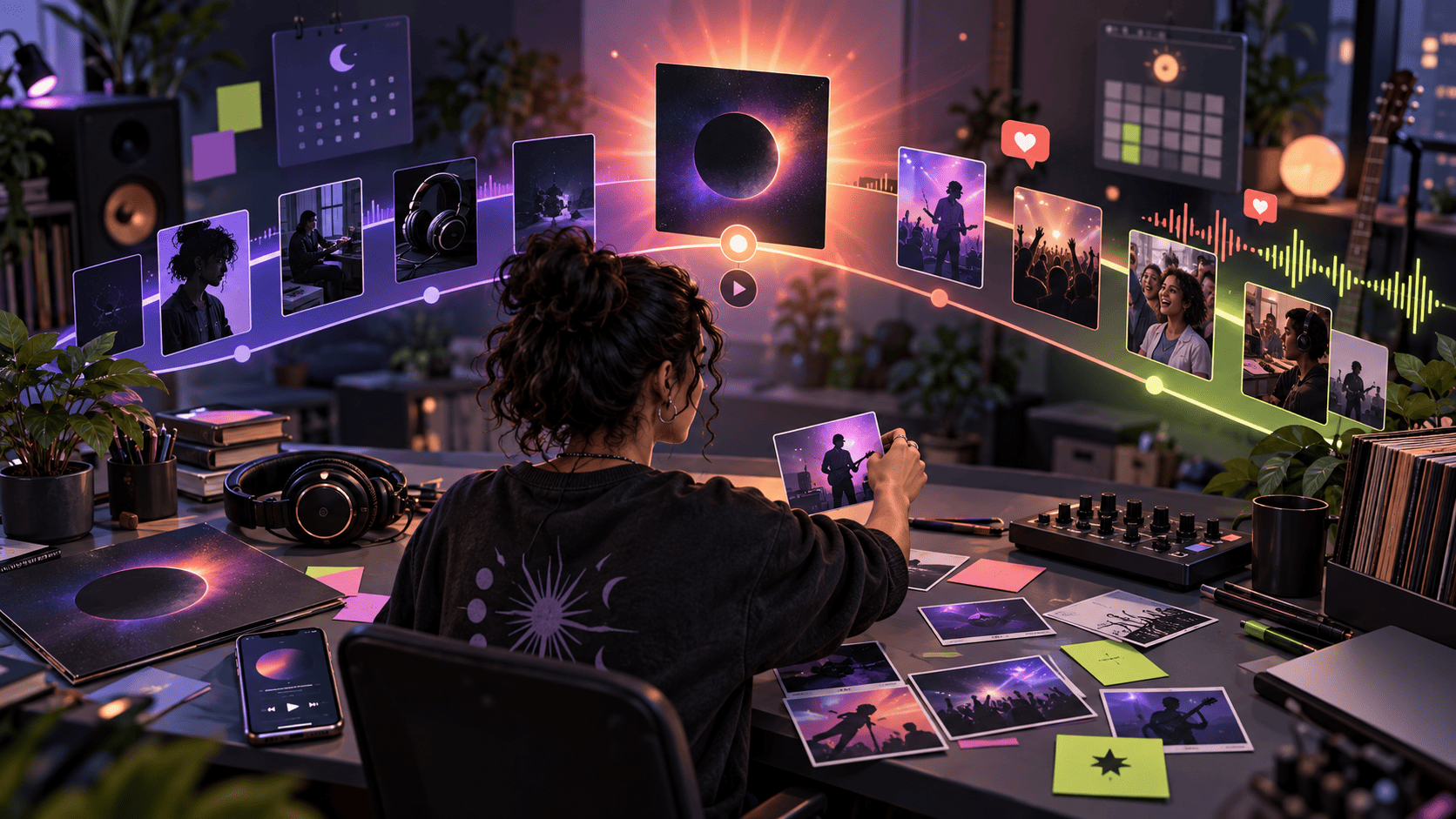
A release campaign should create recognition before launch and
continue giving new listeners entry points after release day.
Plan a release as a story, not one announcement
A release campaign should create recognition before the streaming link appears. If the first time followers hear about your single is “out now,” you are asking one post to do all the work.
Three to four weeks before release: introduce the world
Start with the feeling, problem, character, or sonic idea behind the song. Share a lyric without explaining everything. Show part of the recording process. Test two different snippets. Your first goal is not conversion. It is finding the angle that makes people react.
One to two weeks before release: build participation
Repeat the strongest idea in new forms. Ask people to choose artwork, guess a lyric, respond to a question, or use an Add Yours prompt. Publish a Collab with a featured artist, producer, dancer, venue, photographer, or another relevant account. Meta says accepted Collab posts can appear on each collaborator’s profile and reach their audiences, which makes the format especially useful when the partnership is real.
Release week: make listening easy
Update the bio and link. Pin the release. Publish a clear “out now” post, but surround it with content that still works for someone who has never heard of you: a performance, story, breakdown, reaction, or live session. Ask for one action at a time.
The two weeks after release: keep creating entry points
A song does not become old because release day passed. Share alternate versions, fan responses, acoustic takes, lyric explanations, rehearsal clips, playlist adds, press, and live footage. Look at what the audience repeated, saved, shared, or asked about, then build the next post from that evidence.
A realistic weekly Instagram plan for an independent musician
You do not need a content factory. Start with one recording session and turn it into a small set of useful pieces. Here is a sustainable example, not a rule:
A sample weekly workflow
Day
Content
Purpose
Monday
Reel with a strong song or story hook
Reach new listeners
Tuesday
Two or three Stories from the process plus a poll
Learn what current followers care about
Wednesday
Carousel explaining a lyric, sound, or decision
Create context and earn saves
Thursday
Community time: thoughtful replies and conversations
Strengthen relationships
Friday
Performance Reel or Collab
Show the music and reach adjacent audiences
Weekend
Informal Stories, a Live, or no post
Connect without burning out
Batch the parts that benefit from batching: filming, editing, captions, and scheduling. Keep room for real moments. The best system lowers the effort required to publish without making the artist feel automated.
Help Instagram and listeners understand your content
Discovery is not one hashtag trick. Instagram needs signals about the content, while people need a clear reason to watch and share it.
Use plain language around the music
Include useful words in the spoken video, on-screen text, caption, and profile when they fit naturally: the genre, city, instrument, mood, artist type, song title, or subject. “Indie folk breakup song recorded in Nashville” gives more context than “something special is coming.” Write for a curious listener, not a keyword list.
Treat hashtags as labels, not a growth strategy
Use a small, relevant set only when it helps classify the post or connect it to a real community. Mix artist, genre, location, event, and campaign terms when appropriate. Avoid filling captions with unrelated high-volume tags. A precise description and content people want to share matter more than chasing a magic hashtag count.
Create legitimate reasons to collaborate
Collab posts work best when both audiences have a reason to care. Think featured artists, producers, venues, festivals, photographers, dancers, vocal coaches, gear makers, local media, or another musician in the same scene. Do not send generic collaboration requests to large accounts just for borrowed reach.
Make original content easy to credit and repost
Publish a clean, strong clip that a fan would genuinely send to a friend. When people repost public content, Instagram credits the original poster; according to Meta, a repost may also be recommended to the reposter’s followers. That makes shareability more useful than manufactured engagement.
Build relationships without living in the app
Instagram rewards attention, but your creative work needs attention too. Set boundaries around community management instead of checking the app all day.
Try two focused sessions of 15 to 20 minutes: one after publishing and one later in the day. Reply to substantive comments. Answer DMs that deserve an answer. Leave thoughtful comments on accounts connected to your scene. Save common fan questions as future content ideas.
Avoid copy-paste comments, follow-for-follow loops, engagement pods, purchased followers, and mass DMs. These tactics can inflate visible numbers while making your analytics harder to trust. A smaller audience that listens, replies, attends, and shares is more valuable than a large audience trained to ignore you.
If direct access to followers matters, build an owned connection too. An email or SMS list can support release reminders, tickets, and merch without depending entirely on one platform’s distribution.
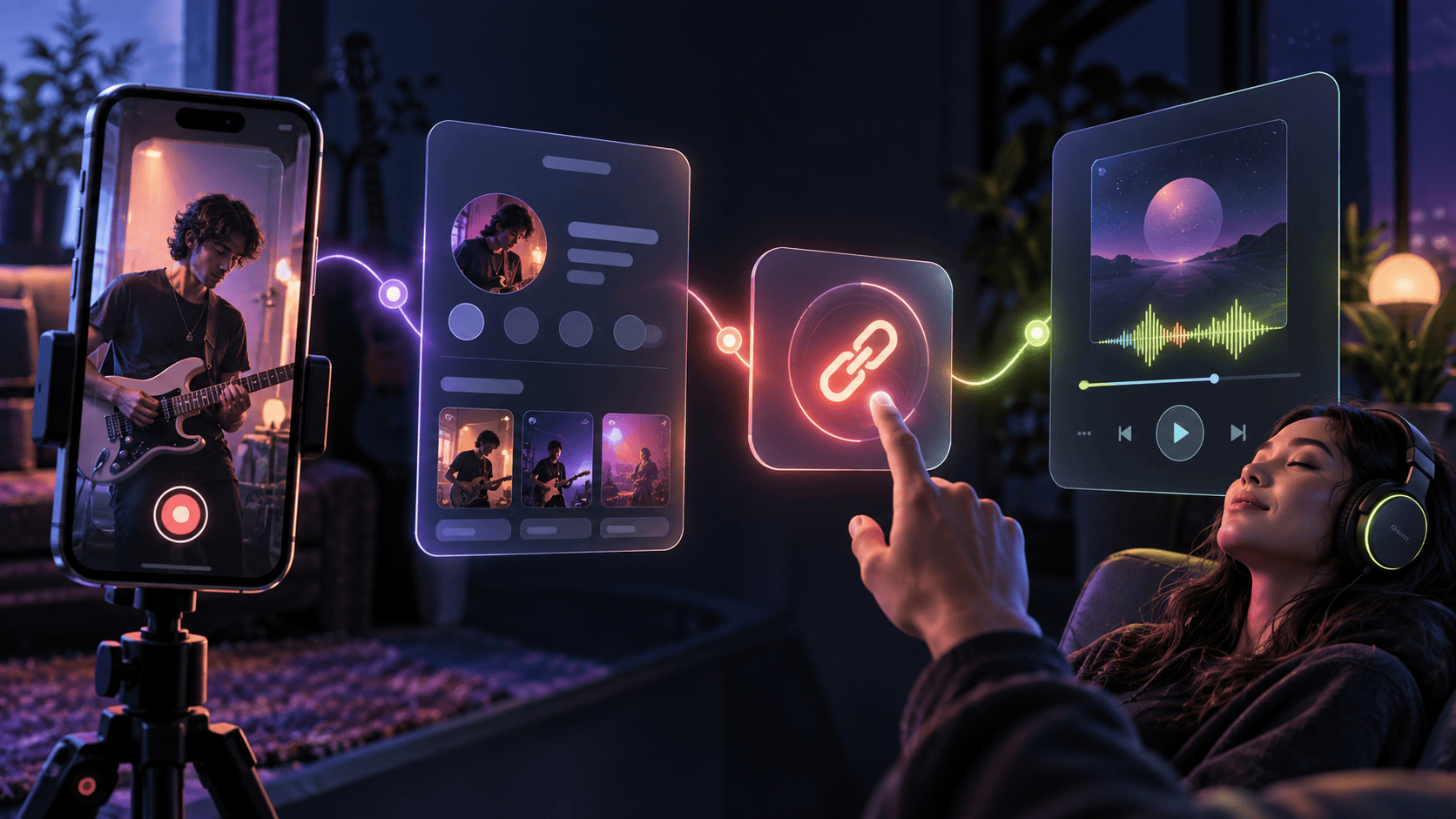
Instagram reach becomes valuable when viewers continue from the Reel
to the artist profile, music link, and full recording.
Measure the path from reach to listening
Likes are easy to see, which is why they receive too much attention. For musicians, the useful metric depends on the job of the post.
Are viewers becoming recognizable, reachable fans?
Review results in groups, not one post at a time. Compare several song-first Reels, several story-first Reels, and several performance clips. Look at the median result so one unusually viral or unusually weak post does not control the conclusion.
Instagram Insights provides performance data for professional accounts and individual posts, Stories, Reels, and Live videos. To benchmark an account with a consistent method, use the free Instagram Account Analyzer for Musicians. For context on the numbers.
Run small experiments instead of chasing every trend
Trends move quickly. A learning system lasts longer.
Choose one variable to test for two weeks:
song-first opening versus story-first opening;
performance footage versus studio footage;
chorus versus verse versus instrumental moment;
direct-to-camera explanation versus on-screen text;
polished edit versus one-take performance;
short caption versus a deeper story;
solo post versus a relevant Collab.
Keep the other variables reasonably stable, publish more than one example, and record the outcome. You are not trying to prove a universal Instagram rule. You are learning how your music, audience, and creative strengths fit together.
The result may surprise you. A rough rehearsal clip can outperform an expensive music-video excerpt because the opening feels immediate. A carousel may send more people to the release than a Reel with ten times the reach. Reach and conversion are different jobs.
Common Instagram mistakes musicians can fix
Posting only announcements. Give people music, context, and participation between promotional asks.
Hiding the best part. A slow cinematic intro may work in a full video but lose a cold audience in a short feed.
Using vague captions. Name the feeling, story, genre, place, or decision that makes the clip specific.
Changing identity every week. Experiment with formats while keeping recognizable musical and visual cues.
Copying trends with no artist fit. Adapt a format only when it helps people understand your music or personality.
Speaking only to other musicians. Technical process content is useful, but give listeners emotional entry points too.
Buying visible numbers. Inflated followers or engagement can distort decisions and weaken trust.
Measuring only likes. Track shares, watch behavior, profile actions, link activity, and downstream music outcomes.
Quitting after release day. Keep creating new ways into the song while it is still new to most people.
Burning out. Build a repeatable system around your real time, energy, and release cycle.
Your seven-day Instagram reset
Choose one goal. Decide what Instagram should help you achieve in the next four to six weeks.
Fix the profile. Make the artist name, bio, link, pinned posts, and Highlights useful to a new listener.
Select three content pillars. Start with music, story, and process or community.
Record one focused session. Capture several hooks, one full performance, and a few behind-the-scenes moments.
Publish one discovery Reel. Lead with the strongest moment and give it one job.
Start a conversation. Use Stories, a poll, comments, or a DM prompt that people can answer honestly.
Record the baseline. Save current reach, engagement, profile visits, link activity, and follower data so you can compare later.
Then repeat what worked, change one thing that did not, and keep the music at the center.
Frequently asked questions about Instagram for musicians
Is Instagram still worth it for musicians?
Yes, if your audience uses it and you give the platform a clear job. Instagram can support music discovery, visual identity, fan conversations, release campaigns, live promotion, and collaborations. It should be part of a broader system that also includes your music platforms, website, and an owned audience channel such as email or SMS.
How often should a musician post on Instagram?
There is no universal number. Start with a schedule you can sustain long enough to learn from it, such as two strong feed posts or Reels per week plus lighter Stories. Quality, clarity, and a repeatable process matter more than forcing daily posts that exhaust you or repeat the same announcement.
What should musicians post on Instagram?
Post the music itself, the story behind it, the creative process, the people involved, and moments that invite fans into the experience. Useful formats include performances, demos, lyric stories, studio clips, alternate versions, tour moments, fan responses, Q&As, and clear release or ticket updates.
How can a musician grow on Instagram without paying for ads?
Create original content with a strong opening, make the artist identity clear, publish consistently enough to learn, collaborate with relevant accounts, respond to the community, and design posts people want to share. Use Insights to repeat formats that reach non-followers and lead to profile actions or listening.
Are Reels the best format for promoting music?
Reels are useful for reaching people who do not follow you, but they are only one part of the system. Stories and DMs can deepen relationships, carousels can explain the song and earn saves, Live can create a shared moment, and a clear profile link can convert interest into listening or ticket sales.
Should musicians use a creator or business account?
Many artists start with a creator account, while labels, venues, and music businesses may prefer a business account. Both are professional account types with access to tools and Insights, but feature and music-library access may differ. Check current Instagram documentation and choose the account that fits how you operate.
How do I promote a new song on Instagram?
Begin before release day. Introduce the song’s feeling or story, test several snippets and hooks, invite fans into the process, use relevant collaborations, update your profile link, and make release-day listening easy. After launch, continue with performances, alternate versions, fan reactions, lyric context, and live footage.
Which Instagram metrics matter most for musicians?
Track metrics that match the post’s job. For discovery, watch non-follower reach, watch time, replays, and shares. For interest, watch profile visits, follows, and saves. For results, track link taps, pre-saves, streams, ticket sales, merch sales, and growth of your owned fan list.
Marie Weber is a Strategic Content Partner and author at JamFeed.
She turns social media data, platform changes, and creator marketing
research into clear, actionable guidance for musicians and creative teams.
Some Instagram photos need more than a basic caption. A leather-jacket selfie, a packed concert venue, a favorite vinyl record, or a guitar under stage lights deserves words that match the energy. That's where a great rock caption comes in.
If Instagram music is not working, start by checking what the problem actually looks like. A missing Music button, an empty song library, “This song is currently unavailable,” and a Reel that loses its audio after publishing can have completely different causes.
If you've just released a song, start your Instagram promotion with a performance clip and a working link to the full recording. Put the song title where people can read it. Share the clip to Stories with a listening link, then try another passage from the same track before deciding what to promote more heavily.
From festival headliners with millions of followers to local event DJs building highly engaged communities, these are the DJ Instagram accounts worth knowing