TikTok for musicians works when a short video gives a stranger one clear reason to stop, hear your song, and remember your name. A million-view fantasy is optional. A repeatable path from discovery to a full listen, a follow, a save, or a ticket sale is the part that matters.
TikTok reported in April 2026 that its Add to Music App feature had produced more than 6 billion track saves to streaming services during the previous 12 months. That number does not guarantee a breakthrough for any one artist. It does show that the jump from a TikTok discovery to intentional listening is real when the song, video, and next step line up.
Updated August 25, 2026. Platform features and account eligibility can vary by region.
The short answer: what works on TikTok for musicians?
A useful TikTok strategy for musicians has four moving parts. Your profile explains who you are. Your videos create many entry points into the same music. Your release plan gives people a reason to return. Your analytics tell you which idea deserves another version.
That last part is easy to miss. One post is a creative choice; ten related posts are a test. If a stripped chorus gets shared while a polished music-video clip gets ignored, your audience has told you what to make next. Keep the chorus. Change the setting, opening line, camera angle, or story around it. Do not abandon the song after one quiet upload.
Virality is a result, not a working method. The method is simpler: choose one song, show it from several honest angles, make the next action obvious, and study what listeners do.
Set up an account people can understand in five seconds
A viewer may meet you halfway through a lyric without any context. When that person opens your profile, the page should answer three questions fast: What kind of artist is this? Which song should I hear first? What can I do next?
Use the same artist name and recognizable image that appear on your streaming profiles. Write a plain bio with your genre, point of view, or current release. "Dream-pop songs for people who text and delete" says more than "artist, dreamer, creator." Add the most useful destination available to your account, such as a release page, show calendar, mailing list, or main artist website.
Pin a small welcome sequence instead of three random high-view posts. One video can introduce your sound, another can carry the current single, and a third can show a live performance or a fan response. Together, they should make a new visitor feel caught up.
Check whether an Artist Account fits your release setup
TikTok's Artist Account can add an Artist tag, a Music tab, release tools, and ways to connect a post with a catalog track. Eligibility and availability can change, so confirm the current requirements inside TikTok before building a campaign around a feature.
Eligible artists with a certified Artist Account can also use TikTok for Artists. TikTok says its dashboard includes daily-updated song, post, and follower data. The platform also offers a Pre-Release tool for supported album campaigns on Spotify and Apple Music. If you work with a manager or label, account access can be shared with the team.
Do not switch account types just because a generic marketing guide tells you to. Music access and commercial-use rules differ between Personal and Business Accounts. Before changing anything, check TikTok's current account guidance, confirm that your distributor delivered the right recording, and make sure you have permission for every sound in a promotional post.
Start with the listener, not the algorithm
"My new single is out" is important to you. It is not yet a reason for a stranger to stop scrolling.
Give the song a human doorway. A folk singer might open with the one line she kept after rewriting the verse 17 times. A producer can mute the drums, ask viewers what feels missing, then reveal the full beat. A metal band can show the rehearsal mistake that led to the best transition in the track. The music remains central, but the viewer now has a question to answer or a small story to finish.
Define your audience by a recognizable moment, not only by age and location. "Alternative rock fans" is broad. "People who still replay the songs they found on burned CDs in high school" gives you images, language, and memories to write from. "R&B listeners" is a category. "Anyone who needs a quiet song for the ride home after a bad date" is a scene.
This changes the question behind every post. Instead of asking, "What does TikTok want today?" ask, "What would make this particular listener care about this particular eight bars?"
Turn one song into a month of TikTok content
Musicians often think they need a new idea for every upload. That creates a second job beside writing, recording, rehearsing, booking, and touring. A better content system pulls many small stories from work you are already doing.
Choose one focus song for the next few weeks. Then look at it through four doors: the finished music, the story behind it, the process of making it, and the listener's chance to join in. These are not rigid content pillars. They are prompts for the days when the camera roll feels empty.
Repeatable TikTok content ideas for musicians
| Video idea |
What the viewer gets |
A useful opening |
| Raw performance |
The song without a campaign around it |
Begin on the strongest lyric, riff, drop, or vocal run |
| Lyric story |
The real situation behind one line |
"I changed one word because the first version was too honest." |
| Demo versus master |
A satisfying before-and-after listen |
Play the voice memo first, then cut straight to the final chorus |
| Isolated part |
A detail hidden inside the mix |
"You can barely hear this harmony, but the chorus falls apart without it." |
| Choice in progress |
A chance to help shape the track or show |
Ask which intro, cover design, set-list position, or guitar tone fits |
| Comment reply |
Proof that the artist listens back |
Put the comment on screen and answer with music, not a speech |
| Genre flip or cover |
A familiar reference through your sound |
Name the two styles before the first note |
| Rehearsal or road moment |
A place inside the working life of the artist |
Show the tension first: the missed cue, broken string, or empty room |
| Fan-use reaction |
Recognition and a reason to create with the song |
React to the specific detail that made the fan's version personal |
| Search-led mini lesson |
An answer tied to your musical skill |
"How I stack indie-pop vocals without making them sound crowded" |
The same chorus can sit inside all ten formats. Repetition helps people recognize a song, while a new setup keeps the post from feeling copied. Change one main variable at a time. If you change the song clip, hook, edit, caption, and audience prompt together, a strong result will not tell you which choice worked.
Give every video one clear job
A TikTok can earn attention, introduce a song, start a conversation, or send someone to the full release. Asking one video to do all four usually leaves it cluttered.
Start at the moment with tension. Skip the walk toward the camera, the explanation of what you are about to play, and the apology for bad lighting. If the reason to watch is a lyric, put that lyric on screen while the line is heard. If the reason is a production change, let people hear the before version immediately.
A hook does not need to sound like an ad. It can be a precise sentence:
"This is the chorus I almost cut because I could not sing it without laughing."
"Our drummer turned the quietest song on the record into this."
"If your bass disappears on phone speakers, try this before adding another plugin."
Use the shortest runtime that completes the idea. A clean 12-second chorus may be enough. A songwriting story may need 45 seconds. A useful breakdown can run longer if each beat earns the next one. Fixed length advice becomes stale quickly; audience behavior on the actual post is a better editor.
Captions should be readable with the sound low, but do not cover your face, hands, instrument, or TikTok's interface. Record clean audio when the music itself is the proof. A close phone recording in a rehearsal room can feel more present than a polished clip with weak sound.
TikTok SEO helps the right listeners find the right video
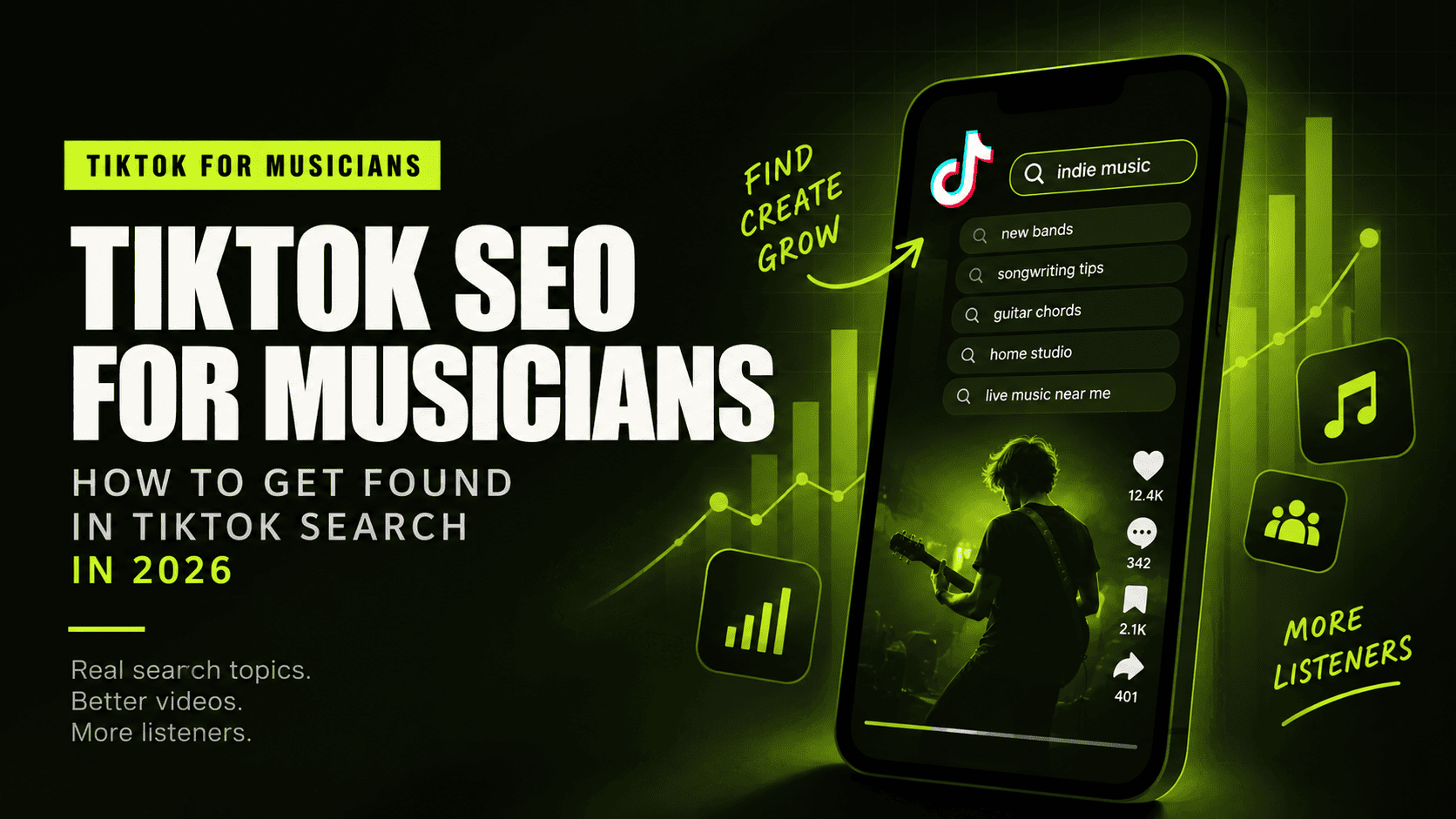
TikTok discovery is not limited to the For You feed. People search for genres, techniques, moods, songs, local scenes, and problems they want to solve. TikTok's Creator Search Insights shows creators topics people are searching for and can help uncover content gaps.
Choose one search phrase that honestly matches the video. Say it naturally, show it in the opening text, and use a close version in the caption. For a tutorial, that phrase might be "how to write a shoegaze guitar part." For a discovery post, it might be "new indie folk songs for a rainy drive." A local band could use "live punk music in Austin" when the clip truly connects to an Austin show.
Write captions for a person who has never seen you. "Wait for it" offers no subject. "The harmony that changed the last chorus of our new alt-pop song" gives TikTok and the viewer useful context.
Hashtags can label the topic, genre, instrument, or community, but a pile of broad tags cannot rescue an unclear video. Use a small, relevant set. Skip tags that promise reach without describing the content. Search visibility starts with a video that answers the query it names.
Build a TikTok music promotion campaign that outlives release day
Release-day-only promotion wastes the most interesting part of a song's life. Listeners can care before the file reaches streaming services, and they can discover it weeks after your scheduled announcement has passed.
Give the campaign enough time to learn. The schedule below is a starting point, not a rule from TikTok.
A practical TikTok release timeline
| Timing |
Main job |
What to post |
| Three to four weeks before release |
Find the entry point |
Test different song moments, stories, and visual settings without forcing a hard sell |
| Two weeks before release |
Repeat what earned attention |
Make new versions of the strongest idea and show how the song was made |
| Final week before release |
Connect interest to a date |
Name the song, share the release date, pin the clearest post, and offer a pre-save when it makes sense |
| Release week |
Make listening easy |
Use the official sound, update the bio destination, answer comments, and post more than one creative angle |
| One to four weeks after release |
Turn response into a second wave |
Share live versions, fan uses, lyric stories, alternate arrangements, and replies to real questions |
When one old song starts moving, follow the audience rather than the calendar. The listener hearing it today does not know that your team stopped promoting it last month. Give that person a live version, the story behind the line, and an easy route to the full track.
Use JamFeed's free Music Release Campaign Planner to map the work across TikTok, Instagram, streaming, email, and press. For the wider campaign beyond one platform, read the music promotion guide.
How often should a musician post on TikTok?
Post often enough to learn, but not so often that the content schedule eats the music career it is supposed to support.
For many independent artists, three to five thoughtful posts per week is a workable six-week test. That is a planning recommendation, not an algorithm requirement. A touring band with daily road footage may post more. A producer who needs two hours to explain each breakdown may post less. Consistency means keeping a pace you can sustain and review.
Batch the setup, not the personality. Put the phone in one position during rehearsal and record four takes of the same chorus with different openings. Save clean clips while tracking vocals. Photograph the lyric sheet before the session ends. Ten extra minutes during work you already planned can supply several posts without inventing a fake life for the camera.
A simple week might include a raw performance, a process clip, a comment reply, and a search-led post. Leave room for an unexpected audience response. If one question keeps appearing, the next video has already been requested.
Use analytics to decide what deserves another take
Views tell you how far a post traveled. They do not tell you whether anyone cared about the artist behind it.
Review each post after it has had time to collect a normal response for your account. Compare related videos instead of judging a 20-second performance against a two-minute production lesson. If you have access to TikTok for Artists, its dashboards can add song-level data, creator engagement, post completion, and follower information to the picture.
What TikTok metrics can tell a musician
| Signal |
What it may mean |
What to test next |
| Average watch time and completion |
The opening held attention, or the payoff arrived soon enough |
Start the next version closer to the part people stayed to hear |
| Shares |
The post expressed something viewers wanted another person to see |
Keep the emotional situation or useful lesson and change the performance |
| Comments with specific questions |
The viewer wants more context, skill, or story |
Answer the strongest question with a video |
| Profile visits and new followers |
The post created interest in the artist, not only the isolated clip |
Check whether the profile and pinned posts continue the same promise |
| Uses of your sound |
The song gives other creators a usable feeling, joke, scene, or format |
Thank those creators, study their use cases, and make the prompt easier to join |
| Streaming saves, follows, or smart-link visits |
TikTok attention is crossing into intentional listening |
Keep the same call to action and improve the route from profile to track |
Track off-platform results in your distributor, streaming, website, or smart-link dashboard. TikTok cannot tell you the whole story by itself. A post with modest reach and a visible lift in track saves may be more useful than a broad comedy clip that never sends anyone to your music.
Look for patterns after a group of posts: which song moment, opening sentence, setting, and audience situation keep returning in the winners? Build the next week from that evidence. JamFeed's music marketing research section can help you separate measured behavior from recycled social-media folklore.
Turn TikTok views into streams, followers, and people you can reach again
The next step should match the viewer's level of interest. Someone hearing you for the first time may only be ready to watch another chorus. A person who has commented on four versions of the song may be ready to pre-save it, join your list, or buy a ticket.
Use one call to action at a time. "Hear the full song in my profile" works when the payoff is the recording. "Which line should I explain next?" works when the goal is another conversation. "Use this sound for the photo you almost deleted" gives a creator a specific reason to make something with the track.
Keep the route clean. The video leads to the profile. The profile confirms the same artist and song. The link opens the promised destination. The streaming page uses the same title and artwork. Small mismatches create doubt and lost clicks.
TikTok's Add to Music App can shorten the route for eligible catalog tracks, while Artist Account tools can make a release easier to find on-platform. You still need places you control. An artist website, email list, and show database let you contact listeners after a feed stops showing the post.
Short-form platforms can work together without becoming duplicates. A TikTok comment may suggest the next Instagram Reel, while an Instagram Story can send existing fans to a TikTok collaboration. Adapt the opening and caption for each audience. JamFeed's Instagram for musicians guide covers that side of the system.
Common TikTok mistakes that slow musicians down
Posting only announcements
Release graphics report news; they rarely demonstrate why the song deserves attention. Let people hear the part, see the choice behind it, or recognize themselves in the lyric before asking for a stream.
Waiting for perfect footage
A clean performance with a clear idea can beat a costly clip that starts slowly. Save polish for the posts that need it. Process, rehearsal, and reply videos often benefit from feeling immediate.
Copying a trend without a musical reason
A trend is useful when your sound or point of view changes it. If viewers remember the format but cannot name the artist or song, the post did somebody else's branding.
Giving up on a song after one post
The first version may have used the wrong opening or shown the least interesting section. Test another moment and another context before deciding the music cannot work on TikTok.
Reading views as fan growth
Reach is only the first step. Watch profile visits, follows, sound uses, track saves, link traffic, and the quality of comments. Those signals reveal whether the attention moved closer to a relationship.
Buying views, followers, or comments
Purchased activity muddies your data and fills the account with people who did not choose the music. You need honest feedback to decide what to repeat. Fake numbers make that decision harder.
Ignoring music rights and account restrictions
Confirm that you control or have permission to use the recording, composition, samples, and visual material in a promotional post. Review TikTok's current commercial music guidance when a brand, sponsor, product, or Business Account is involved.
A 30-day TikTok plan for an independent musician
Days 1 through 3 are for setup. Clean the bio, confirm the artist name and links, choose one focus song, and collect existing rehearsal, studio, live, and voice-memo footage. Write down five listener situations that fit the song.
From Day 4 through Day 10, publish four different entry points: a direct performance, the story behind one line, a process detail, and a post built around a specific search phrase. Keep the song moment consistent enough to compare the response.
During Days 11 through 17, make two new versions of the strongest post. Change the opening or setting, not everything. Reply to at least one useful comment with a video. Spend more time in the comment section than on decorative editing.
Days 18 through 24 are for participation. Invite a choice, show an alternate arrangement, duet or stitch a relevant creator when permission and context are clear, and acknowledge any genuine use of your sound. If the release is live, make the full track easy to find.
Use Days 25 through 30 to review the month. Keep the formats that created profile visits, specific comments, follows, sound uses, or listening activity. Retire the ideas that repeatedly attracted the wrong audience. Then choose the next focus song or continue with the current one if listeners are still arriving.
This plan gives you evidence without demanding a full-time creator schedule. Adjust the pace around rehearsals, shows, health, work, and the time required to make good music.
TikTok for Musicians FAQ
Is TikTok good for musicians?
Yes, especially for music discovery, direct fan conversation, and testing which song moments earn a response. TikTok is less useful when an artist treats raw views as the final goal. Connect each post to a follow, sound use, full listen, save, email signup, or show action that fits the campaign.
How do musicians get noticed on TikTok?
Lead with the strongest musical or emotional moment, give it clear context, and make several versions before judging the idea. Specific listener situations, comment replies, collaborations, search-led posts, and recognizable series can help people understand why they should stay.
What should musicians post on TikTok?
Post the music, the decisions behind it, the work of making it, and ways listeners can take part. Useful formats include raw performances, lyric stories, demo comparisons, isolated stems, rehearsals, fan responses, covers, genre flips, production lessons, and video replies to comments.
Do musicians need to dance on TikTok?
No. Dance can fit a song, but it is one format among many. Singers can perform, bands can document rehearsal, producers can break down a sound, songwriters can explain a line, and instrumentalists can teach or reinterpret a familiar part.
How often should musicians post on TikTok?
Choose a schedule that produces enough posts to compare without damaging your music work. Three to five posts per week is a reasonable test for many independent artists, but it is not a platform rule. Quality, learning, and a sustainable pace matter more than copying somebody else's volume.
How do I promote a song on TikTok without annoying people?
Change the value around the same song. One post can reveal a lyric story, another can show the demo, and another can ask listeners to choose between two arrangements. Repeating the track builds recognition; repeating the exact sales message creates fatigue.
Which TikTok hashtags should musicians use?
Use hashtags that accurately name the genre, instrument, location, topic, or listener community in the video. A few precise tags are more useful than a long row of broad reach tags. The spoken words, on-screen text, caption, and actual content should all point to the same subject.
Should I use a Personal, Business, or Artist Account?
The right choice depends on your catalog, rights, location, and account goals. Many released musicians benefit from Artist Account features when eligible. Business Accounts follow different music-access rules, so review TikTok's current documentation and talk with your distributor or rights team before switching.
How can TikTok views become music streams?
Use the official track when available, keep the artist name and artwork consistent, point interested viewers to one clear destination, and compare TikTok activity with streaming or smart-link data. TikTok's Add to Music App can also let listeners save eligible songs directly to a supported streaming service.
What should I do when a TikTok video gets very few views?
Check whether the song or subject was clear in the opening, whether the payoff came too late, and whether the post reached the right audience. Make another version with one deliberate change. Judge patterns across several related posts, not your ability as an artist from one upload.
Official TikTok resources used for this guide
Make the next post a useful test
Open your camera roll and choose one unfinished moment that already contains tension: a missed note, a crossed-out lyric, a rough voice memo, or the take that surprised the room. Pair it with the strongest part of one song. Tomorrow, change the opening rather than changing the song.
After ten related posts, the audience will have given you something more useful than a guess. You will know which part makes people stop, which story makes them answer, and which route sends them toward the music.
Plan your next music release with JamFeed or explore more free tools for musicians.