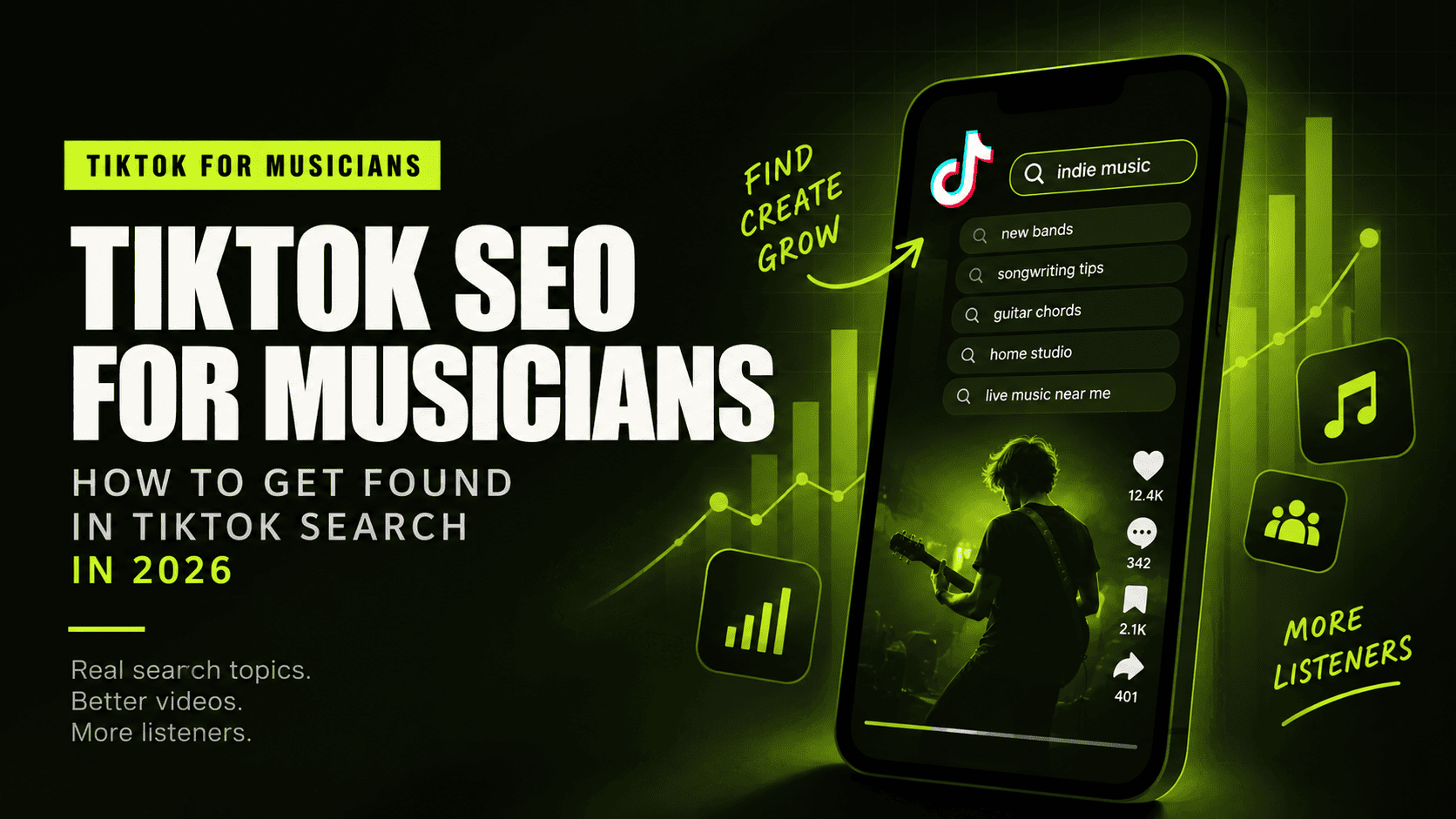
People don't open TikTok only to scroll the For You feed. They search for things: a new band, a guitar sound, songs for a certain mood, a production fix, live music in their city. If your video gives them the answer they're looking for, it can keep getting discovered after the first burst of feed traffic has disappeared.
That makes TikTok search useful for musicians, especially when you make music that fits a recognizable genre, scene, mood, technique, or listener problem. The trick is choosing searches that actually connect with your music instead of stuffing keywords into videos that nobody wanted in the first place.
This guide shows you how I'd approach that process: find a useful search, build one video around it, publish it with enough context for TikTok to understand the subject, then check whether those views are leading anywhere useful.
By Marie Weber · Published September 4, 2026 · 12 min read
The short answer
TikTok SEO for musicians starts with a search someone might realistically make. Build the video around that need. Say or show what the video is about early, use an accurate on-screen title when it helps, write a caption that describes the actual content, and add hashtags or sounds that give TikTok useful context.
Then look beyond the raw view count. Search traffic matters, but so do profile visits, saves, follows, sound opens, smart-link clicks, and listening activity.
There isn't a published formula that tells you how to rank first in TikTok search. TikTok documents several signals used in recommendations, including user interactions and video information such as captions, sounds, and hashtags. Its Creator Search Insights feature can also show what people are searching for and where TikTok sees content gaps. That's a much better place to start than somebody's made-up percentage chart for “the algorithm.”
What matters most
- Give each video a clear search job.
- Choose topics that genuinely fit your music, skills, scene, location, or creative process.
- Use Creator Search Insights and TikTok search to see how people phrase those needs.
- Keep the video, caption, on-screen text, hashtags, and sound pointed at the same subject.
- Judge results by what the right viewers do after finding the video, not only by how many impressions it gets.
And be careful with claims about ranking factors. TikTok publishes useful information about recommendations, but it doesn't publish fixed weights for keywords, completion rate, rewatches, shares, or most of the other numbers you'll see repeated in marketing posts.
Contents
- What TikTok SEO means for musicians
- What TikTok actually says about discovery
- How to find TikTok keywords for music content
- The JamFeed search-to-listener map
- How to optimize one TikTok video
- TikTok search video ideas for musicians
- Where hashtags and sounds fit
- A 14-video TikTok SEO test
- How to measure the result
- TikTok SEO mistakes worth avoiding
- Frequently asked questions
What TikTok SEO means for musicians
TikTok SEO means making a video that has a good chance of matching a relevant TikTok search. You start with something a person wants to find, then make the subject of the video clear enough that the viewer and the platform can understand it.
For a musician, the search might be about the music itself. Someone could look for “new shoegaze bands,” “sad piano songs,” “underground techno Berlin,” or “indie songs for late night drives.” In those cases, the track can provide the answer.
Other searches are built around what the artist knows. A producer can answer “how to make vocals clearer in a dense mix.” A guitarist can show “easy shoegaze guitar chords.” A songwriter can explain how they changed a weak second verse.
This gives you a lot more material than repeatedly announcing that your new single is out.
Search also creates a slightly different situation from the For You feed. A person scrolling the feed didn't ask to see you. You have to earn their attention from zero. A person who searched “live jazz in Chicago this weekend” has already told TikTok what they're interested in.
You still need a good video. But now you know something about why that viewer arrived.
What TikTok actually says about discovery
It's useful to separate TikTok's own documentation from the theories that circulate around it.
In its public explanation of the For You recommendation system, TikTok describes several broad types of information. These include user interactions, information about the video, and device or account settings. Video information can include captions, sounds, and hashtags.
TikTok has also explained that stronger expressions of interest can matter more than weaker contextual signals. Finishing a longer video is one example it has used. In the same documentation, follower count and an account's history of viral videos aren't presented as direct recommendation factors.
There's an important limitation here. Documentation about the For You feed doesn't give us a complete formula for TikTok search.
TikTok hasn't published a table telling creators that completion is worth 40%, keywords are worth 20%, rewatches are worth 15%, and so on. When you see numbers like that, check where they came from before building a strategy around them.
| Claim | What we can verify publicly | What I'd do with that information |
|---|---|---|
| Captions, sounds, and hashtags give TikTok information about a video | TikTok includes them in the video information used for recommendations | Use them to describe what is genuinely happening in the video |
| User interactions influence recommendations | Yes | Make a video that satisfies the person who chose to watch it rather than treating the keyword as the finish line |
| You need a large follower count to get discovered | TikTok does not describe follower count as a direct For You recommendation factor | A small account can still target a relevant search |
| Every TikTok is first shown to exactly 200–500 people | That fixed number isn't confirmed in the TikTok documentation cited here | Don't base publishing decisions on a supposed universal test group |
| Completion rate has a universal 40–50% ranking weight | No fixed public weight is provided | Watch completion because it's useful behavior data, but don't treat one percentage as a universal ranking rule |
How to find TikTok keywords for music content
I wouldn't start this process with the biggest keyword you can find. Start with fit.
A useful TikTok search topic describes something your intended listener or another musician actually wants, and gives you something credible to show them.
Imagine a death-metal band chasing “morning study music” because it appears to have a large audience. Maybe the video gets some accidental exposure. It still tells you very little about whether people who could like the band are finding it.
Start with Creator Search Insights
TikTok's Creator Search Insights is the obvious first place to look when it's available on your account.
TikTok says the tool can surface search topics and recommended subjects. It also provides a Content gap filter designed to show searches that have interest but relatively little matching content. Search analytics can help you inspect how your published posts perform in search.
Availability can vary by account, market, and product update, so work with the options you actually see rather than following an old screenshot step by step.
- Open Creator Search Insights from TikTok search or your available creator tools.
- Enter something close to your real work: a genre, instrument, production technique, city, listener mood, or current track.
- Save searches that could lead to a video you'd make even if SEO wasn't involved.
- Check Content gap topics and look for questions you can answer from genuine experience.
- Search the promising terms yourself and watch the current results before recording.
That last step matters. A search can look perfect on paper and still have an existing result page that tells you to approach the idea differently.
Use TikTok search like the person you're trying to reach
Autocomplete and related searches can show you the words people use around a topic. Research in the language and country you're targeting where possible. TikTok results can be personalized, so one phone screen shouldn't be treated as a universal ranking report.
Move from broad subjects toward actual needs:
- indie music → indie music for late night drives
- guitar → easy shoegaze guitar chords
- music production → how to make drums hit on phone speakers
- live music → live jazz in Chicago this weekend
- songwriting → how to finish a chorus when you're stuck
The more specific search will often have a smaller audience. That's fine when those people are much closer to the kind of listener or creator you want.
Your comments are keyword research too
Pay attention when the same question keeps coming back.
Save questions from TikTok comments, DMs, live chats, YouTube, email replies, and conversations after shows. Keep the words people actually use.
Someone asking, “What pedal makes the guitar sound underwater?” has just handed you a much better video idea than a generic topic such as “guitar effects tips.”
The JamFeed search-to-listener map
We've found it useful to plan search content by looking at what the person wants before thinking about the keyword itself. The framework below has six common intents for music content.
This is a JamFeed editorial framework. It isn't a description of internal TikTok search categories.
| What the person wants | Example search | Video that fits | Reasonable next step |
|---|---|---|---|
| Find something to listen to | dream pop songs for a rainy night | Open on the part of the track that best matches the mood | Listen to the full song |
| Learn a technique | how to sing quiet high notes | Demonstrate one useful exercise and then use it in context | Watch another performance or lesson |
| Understand a song | meaning behind [song title] | Explain a lyric, sound, or production decision you can speak about firsthand | Listen again with that context |
| Discover a local scene | new punk bands in Toronto | Use rehearsal or live footage and make the location obvious | Follow the band or check the next show |
| Fix a production problem | how to make vocals clearer in a dense mix | Play the before and after, then explain what changed | Save the video or explore the producer's work |
| Take part in something | open verse challenge indie pop | Give other creators a usable section and a clear prompt | Use the sound, duet, or stitch |
Look across each row before you record. The search, video, and next action should make sense for roughly the same person. If they don't, the topic probably needs to be narrower.
How I'd optimize one TikTok video for search
1. Pick one search need
Write the search at the top of your notes before you script anything.
“How I make shoegaze guitar sound wide in mono” gives you a job to do. A sheet containing 20 variations of “shoegaze,” “guitar,” “guitar tips,” “music production,” and “new music” doesn't.
You can naturally use related words while you speak. You don't need to make one video target every variation.
2. Give the searcher a reason to stay immediately
If somebody chose your result from search, make it clear that they landed on the right video.
For a sound tutorial, play the result early. For a local show, put the venue or city where people can see it. For a song recommendation, don't spend ten seconds explaining your posting schedule before anyone hears the track.
Slow opening: “Hey everyone, I haven't posted for a while, but I wanted to share something with you.”
Useful opening: “Here's how this shoegaze guitar stays wide even through one phone speaker.”
3. Make the subject easy to understand
If you speak in the video, mention the topic naturally. Put a short title on screen when it helps someone understand the clip. Write a caption that describes what the person actually gets.
Those pieces should reinforce one another. You don't need to recite an exact keyword six times. That usually makes the video harder to watch.
4. Use the music as evidence
Musicians have something a generic SEO tutorial doesn't: people can hear the result.
Play the chorus. Show the chord change. Let people hear the mix before and after the adjustment. Sing the vocal exercise and then the finished line.
If you're explaining an audible difference, the comparison is usually more useful than another paragraph of explanation.
5. Choose a CTA that fits why the person searched
A producer who finds your kick-and-bass tutorial may save the video and leave. That's still useful behavior.
Someone searching for “sad folk songs about moving away” is in a different state of mind. If they like the clip, hearing the full track is a natural next move.
Ask for the next sensible action. You don't need every searcher to become a fan, join a mailing list, buy a ticket, and stream the album from one 30-second video.
6. Check what happens after the video
If the clip names a song, make sure the profile and destination use the same artist name and track title. If an official sound exists and is correctly connected to the release, use it when it makes sense.
A listener who likes a song shouldn't have to investigate whether the artist on TikTok and the artist on Spotify are the same person.
TikTok search video ideas for musicians
Use these as structures rather than scripts to copy line for line.
Independent artist
Search: sad indie songs about outgrowing a hometown
Opening: “I wrote this for anyone who misses a hometown they couldn't stay in.”
What to show: Start with the lyric that carries that tension.
Possible caption: A sad indie song about leaving home and feeling guilty for wanting more. “Northbound” is out now.
Band
Search: live post-punk bands in Manchester
Opening: Start while the band is already playing and show Manchester or the venue name on screen.
What to show: Pick the section that best captures the band's live sound.
Possible caption: Live post-punk from Manchester, recorded at [venue]. Next show: [accurate date and location].
Producer
Search: how to make kick and bass work together
Opening: “If your kick disappears when the bass comes in, listen to these two versions.”
What to show: Play a level-matched before and after. Then explain the change you're demonstrating.
Possible caption: One way to create space between kick and bass without turning either one up.
Singer
Search: how to sing softly without sounding breathy
Opening: Sing the breathy version and the clearer version first.
What to show: Demonstrate one exercise, then use it on a line from your track.
Possible caption: A quiet-vocal exercise I use before singing this section live.
DJ
Search: melodic techno transition tutorial
Opening: “This transition works because I leave one rhythm from the outgoing track in place.”
What to show: Let people hear the complete transition before breaking it down with the channels visible.
Possible caption: Melodic techno transition breakdown: what stays, what drops out, and where the next bass enters.
Songwriter
Search: how to write a second verse
Opening: “When my second verse starts repeating the first, I change whose point of view we're hearing.”
What to show: Sing the old line followed by the rewrite.
Possible caption: Rewriting the second verse of this demo, and why one line had to go.
Where hashtags and sounds fit into TikTok SEO
TikTok includes captions, sounds, and hashtags in the video information used by its recommendation systems. I treat them as context.
Use hashtags when they tell TikTok or the viewer something real about the post: the genre, instrument, production technique, scene, city, venue, or community.
A producer discussing bass could use a relevant production tag and a genre tag. A band posting from a show can name the city or venue if the video is genuinely tied to that location.
What I'd avoid is adding unrelated high-volume tags because they're popular. A million extra impressions from people who couldn't care less about the music aren't automatically useful.
Sounds deserve the same treatment. If you're promoting an original release, the correctly delivered official sound can give listeners and other creators a direct path to the track. If the video is a tutorial or commentary post, check that the music you're using is permitted for your account and commercial context.
A trending sound only helps when it fits the video you're making.
A 14-video TikTok SEO test for musicians
If you want to know whether search can work for your account, don't compare fourteen completely unrelated uploads.
Choose one song, skill, genre niche, or local scene. Then make fourteen related posts that let you change one useful variable at a time.
| Videos | What to publish | What you're trying to learn |
|---|---|---|
| 1–3 | Try three different search intents around the same subject: discovery, process, and a direct question | Which kind of searcher responds best to what you make? |
| 4–6 | Stay with the strongest intent and test more specific searches | Which problems or phrases bring in the most relevant viewers? |
| 7–9 | Keep the search topic similar and change the opening | Does result-first, question-first, or story-first hold attention better? |
| 10–11 | Turn two real comments or related searches into follow-up videos | Does the audience's own wording improve the subject? |
| 12–13 | Connect the strongest topic to a full track, profile series, live show, or release page | Does search discovery move beyond the individual video? |
| 14 | Make another version of the strongest concept with one deliberate change | Can you repeat the result? |
Try not to change the topic, hook, length, caption, sound, editing style, and CTA in the same test. You won't know what you learned.
Keep a simple record of the search topic, publication date, format, search traffic, watch behavior, profile activity, and any off-platform action you can observe.
If the experiment is part of an upcoming release, you can map the wider campaign with JamFeed's free Music Release Campaign Planner.
How to measure whether TikTok SEO is working
Start by remembering what the video was supposed to accomplish.
A production tutorial may work because it earns search views and saves. A song-discovery post should make some people curious about the track or artist. A local live-music video has done something useful when it reaches people who could realistically care about the show.
| Signal | What it can tell you |
|---|---|
| Search views or search analytics | Is TikTok showing the post for relevant searches? |
| Average watch time and completion | Did viewers stay long enough to get the answer you promised? |
| Saves and useful comments | Did people find the video valuable enough to keep or discuss? |
| Profile visits and follows | Did interest in the subject carry over to the artist? |
| Official sound opens or uses | Did viewers move toward the recording or use it in their own content? |
| Smart-link clicks, track saves, and streaming activity | Is some of the TikTok interest turning into intentional listening? |
Don't make the final call after a few hours. Search traffic can keep arriving after the initial feed push has slowed down.
Attribution also gets messy once somebody leaves TikTok. Platform analytics, smart-link data, streaming dashboards, and timing can help you build a picture, but they won't prove that every stream came from one organic TikTok post.
Use the evidence you have and keep the conclusion at the same level of certainty.
TikTok SEO mistakes musicians should avoid
The keyword is right, but the video isn't
You can put a perfect search phrase in the caption and still disappoint everyone who clicks the result. If the video takes too long to reach the subject or barely answers the search, the optimization work hasn't solved the main problem.
Targeting “music” when you have something much more specific
Use the details that help the right person recognize the video. Genre, mood, instrument, city, technique, and listening situation are often far more useful than a huge generic term.
Selling in every video
A good tutorial can simply be a good tutorial. A rehearsal clip can show the band at its best. When the connection to your music is natural, people don't need a sales pitch every few seconds.
Repeating precise algorithm numbers you can't verify
Fixed test audiences, universal completion targets, exact ranking percentages, and guaranteed hashtag formulas sound useful because they're precise.
Precision doesn't make them documented.
Keep official TikTok information separate from your own account observations and from third-party theories.
Treating a search label as the final result
Seeing a relevant suggested search above a TikTok can be encouraging. It still doesn't tell you whether anybody became interested in the artist, opened the sound, saved the song, or bought a ticket.
Follow what happens next.
Ignoring music rights or account differences
Access to sounds and the rules around commercial music can differ by account type, rights ownership, region, and campaign context. Check the current rules before you plan a series around audio you may not be able to use.
TikTok SEO for musicians: frequently asked questions
What is TikTok SEO for musicians?
TikTok SEO for musicians is the process of creating music-related videos around searches people make on TikTok. You choose a useful topic, answer it clearly in the video, describe the subject accurately, and then measure whether relevant viewers find and respond to the content.
How do I find TikTok keywords for my music?
Start with Creator Search Insights when it's available, then use TikTok autocomplete, related searches, current search results, and questions from your existing audience. Search around your genre, instrument, production process, location, song story, or listener mood. Pick topics you can answer convincingly.
Where should I use keywords on TikTok?
Make the subject obvious in the video first. You can also use a natural version in your spoken introduction, on-screen title, caption, and relevant hashtags. Keep those elements consistent with the content instead of repeating an exact phrase mechanically.
How many keywords should one TikTok video target?
One main search need is usually enough. Related language can appear naturally, but once the viewer's reason for searching changes, you're probably looking at another video idea.
Do hashtags help musicians rank in TikTok search?
TikTok describes hashtags as part of the video information used by its recommendation systems. Use hashtags that accurately describe the genre, subject, technique, location, or community involved. TikTok doesn't publish a guaranteed hashtag count that puts a video at the top of search.
Does watch time matter for TikTok SEO?
TikTok has publicly described viewing behavior, including completed views, as meaningful recommendation signals. A search result also needs to keep the person who selected it interested. Watch time is worth monitoring, but there isn't one published completion percentage that guarantees a TikTok search ranking.
Can a new musician appear in TikTok search with few followers?
Yes, a small account can still be discovered. TikTok's public explanation of the For You system doesn't describe follower count as a direct recommendation factor. An existing audience can give an established account more initial viewing opportunities, but you don't need a large following before you start making useful search content.
How long does TikTok SEO take?
There's no dependable timetable. Some posts start receiving search traffic quickly. Others build gradually, and plenty never become meaningful search results. Look at a group of related videos rather than asking one upload to prove the whole strategy.
Sources and editorial method
This guide keeps TikTok's documented features and recommendation signals separate from JamFeed's practical suggestions. The product documentation used here was checked on September 4, 2026. TikTok can change features, interfaces, availability, and ranking systems by market or account.
- TikTok Help Center: Creator Search Insights
- TikTok Newsroom: Get inspired with Creator Search Insights
- TikTok Newsroom: How TikTok recommends videos for the For You feed
For more context, see JamFeed's TikTok for Musicians guide, the platform updates tracker, and the 2026 Independent Artist Promotion Platform Audit.