JamFeed Research | October 8, 2026 | By Marie Weber
AI marketing is changing in a way that most software comparisons fail to capture. The interesting question is no longer just how artificial intelligence can write a better advertisement or generate a social media image. It is whether an entirely fictional person can become a recognizable influencer, develop an audience, sell advertising and even launch a music career.
Jean Philanthrope and Abu Shalab offer two remarkable examples. These AI-generated characters attracted hundreds of thousands of Instagram followers and millions of video views in a matter of weeks. Their popularity raises questions about the future of AI Instagram marketing, the value of social media followers and the increasingly blurred boundary between entertainment and advertising.
At JamFeed, we are especially interested in what happens next. Could independent musicians create virtual versions of themselves? Could a hip-hop artist launch a separate AI rock performer using original lyrics? And could networks of fictional personalities become businesses that rival conventional influencer brands?
This article examines the available evidence, explains what it does and does not establish, and develops five predictions about AI in digital marketing and the music industry.
AI Marketing Is Becoming More Than a Collection of AI Marketing Tools
Most articles about AI in digital marketing describe familiar applications: automated advertising, content generation, predictive analytics, chatbots, personalized recommendations and campaign optimization. These technologies are already part of many marketing workflows, and they remain important.
But they do not fully explain the emerging AI influencer economy.
Consider a marketing agency using artificial intelligence to generate ten variations of an Instagram advertisement. The product remains the same, the customer remains human and AI functions as a production tool. Now consider a fictional character who publishes videos, develops recognizable habits, appears to have an everyday life and attracts an audience of hundreds of thousands of people.
In the second example, artificial intelligence is not simply assisting the campaign. It is helping create the identity around which the campaign exists.
AI influencer marketing is the use of synthetic or AI-assisted personalities to attract attention, build audience relationships and potentially support commercial or creative projects. It is one application of the broader field of AI marketing, rather than a replacement for conventional advertising, analytics or automation.
This distinction matters because an AI-generated personality can potentially become a media asset. It may have a recognizable appearance, a distinctive personality, recurring storylines and an audience that follows the character for entertainment rather than for a particular advertised product.
We are beginning to see that possibility in public. Jean Philanthrope and Abu Shalab are especially useful examples because their popularity developed in plain view, even though the full marketing strategies behind them have not been independently established.
Jean Philanthrope: When a Fictional Instagram Character Becomes a Viral Trend
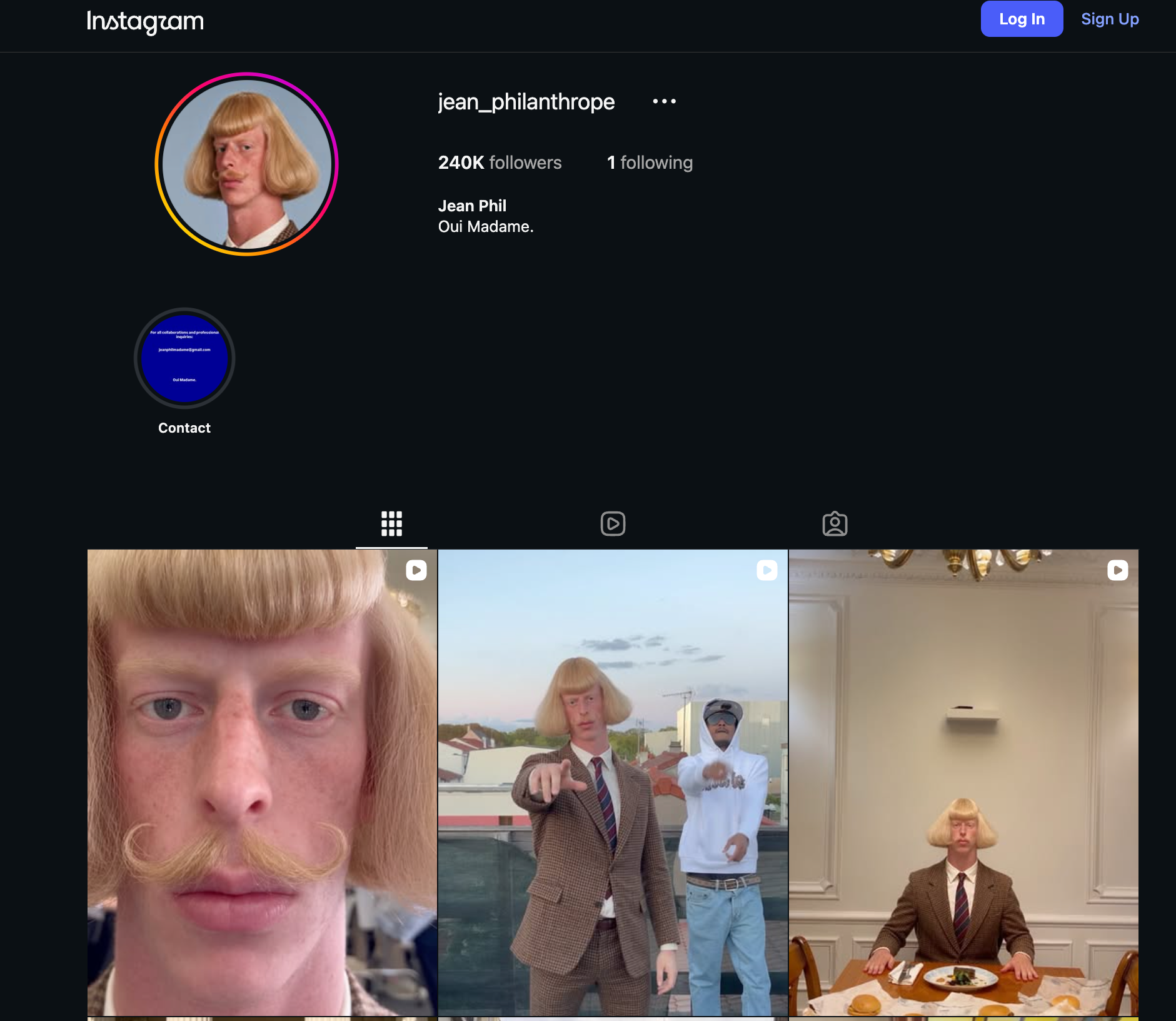
In September 2026, social media users began sharing videos featuring a peculiar French gentleman with a blond bob haircut, curled moustache and formal clothing. He appeared in ordinary settings, including streets, restaurants and public spaces, before suddenly shadowboxing with an expression of complete seriousness.
The character, known as Jean Philanthrope or Jean Phil, did not need elaborate dialogue or complicated stories. His appearance was distinctive, his behavior was immediately recognizable and the joke could be understood without knowing much about him.
There was one unusual detail: Jean Phil was not a real human influencer. He was an AI-generated personality.
By the end of September 2026, public reports documented more than 230,000 Instagram followers and tens of millions of video views across social platforms. Some individual videos reached millions of viewers.
For a character with such a short public history, that is a remarkable amount of attention. It does not reveal precisely how his creators generated every view, but it shows that a synthetic identity can become a widely recognized entertainment format.
The most interesting feature of Jean Phil is not his artificial appearance. It is the simplicity of his identity.
Why the character was easy to recognize
Jean Phil combines a memorable visual design with predictable behavior. Viewers can recognize his hairstyle, clothing and moustache before anything important happens in a video. When the shadowboxing begins, the audience immediately understands the recurring joke.
That gives the character a useful property for short-form entertainment: each video can introduce a new location while preserving the same recognizable identity. The setting changes, but the central concept stays familiar.
For marketing professionals, this is a useful lesson in character design. Visual realism is not necessarily the most important feature of an AI influencer. Recognizability and a repeatable creative idea may matter more.
Why the format could spread
Jean Phil's videos also encouraged imitation. Other creators began producing related AI personalities, changing their clothing, locations, national characteristics or behavior while preserving recognizable elements of the original concept.
This is familiar from traditional internet memes. A format becomes popular, people adapt it and the resulting variations generate additional interest in the trend.
AI can make such creative variations easier to produce. Instead of organizing a conventional shoot for each idea, creators may generate or transform visual material using AI-based video production techniques. The quality of the results still depends on creative judgment and production work.
The important observation is that the character became both an entertainment product and a format other creators could reinterpret.
Source: Sprites' Jean Philanthrope profile and September 2026 timeline.
Abu Shalab: Another Example of AI Instagram Marketing at Scale
Jean Philanthrope was not the only synthetic personality attracting attention during this period.
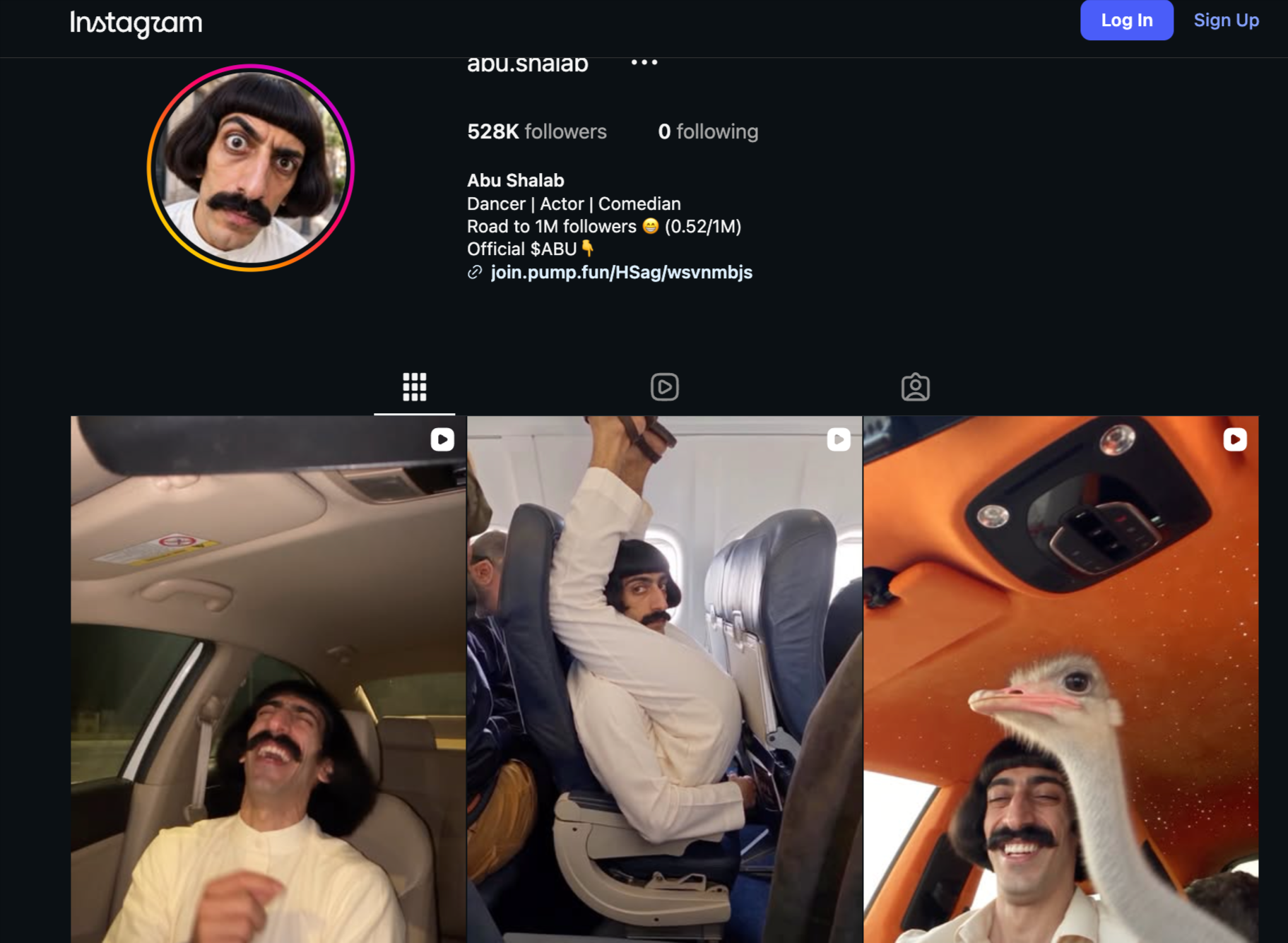
Abu Shalab, a character associated with the Instagram account @abu.shalab, developed a substantial audience through distinctive AI-generated videos. The account became another example of how an easily recognizable fictional identity could spread through short-form entertainment.
An analysis published on October 7, 2026, reported approximately 524,000 followers and around 183 million visible video views associated with the account. These were historical observations, not independently verified live counts, but they suggest the substantial scale the account had reached by early October.
In other words, we now have more than one prominent example of a synthetic social media character attracting attention comparable to that of established human creators.
Two characters, similar marketing questions
Jean Phil and Abu Shalab have different visual identities and content styles. What connects them is their dependence on character recognition and short-form video rather than on a conventional human biography.
Neither account needs to show a real person's ordinary life. Their fictional identities allow the creators to choose settings, appearances and recurring actions that serve the content format.
Yet an important question remains unanswered: which marketing strategies were responsible for their growth?
Was the audience mainly driven by organic recommendations? Did reposts and media coverage accelerate discovery? Were paid promotional campaigns involved? Did the creators have existing communities that helped distribute their first videos?
Public follower counts and view totals cannot answer those questions by themselves.
That uncertainty is part of the research problem. Popularity is visible. The mechanisms producing it are often much harder to establish.
Sources: ScamAdviser, October 7, 2026, and a comparative review of related AI-character accounts, October 2026.
What AI Instagram Marketing Can Learn From Jean Phil and Abu Shalab
These examples are useful because they allow us to examine observable aspects of AI-driven social media entertainment without pretending to know the private decisions of the teams operating the accounts.
Character recognition can matter more than technical realism
Neither concept requires viewers to believe they are watching an ordinary human influencer. The characters attract interest because their visual identities and behavior are memorable.
For a future AI influencer, that may be a stronger starting point than attempting to create a perfectly realistic person with no distinctive personality.
A repeatable format can give audiences a reason to return
An isolated viral video does not necessarily create a lasting audience. A recognizable character with recurring behavior may give viewers a reason to watch several videos and anticipate the next installment.
That is familiar from television comedy, animation and serialized entertainment. AI-generated characters may be bringing similar storytelling principles into short-form social media.
Distribution and creative quality are separate problems
A character can look impressive while attracting little attention. Another can appear deliberately absurd yet reach millions of viewers. Production quality matters, but it does not replace the need for a concept people want to share.
Similarly, follower growth does not automatically demonstrate business value. Before calling an AI influencer campaign commercially successful, we need to examine the quality of its audience and what that audience actually does.
AI makes experimentation easier, not success automatic
AI tools may reduce the cost of producing visual variations, different settings and experimental formats. However, easier production can also lead to more competition and repetitive content.
When thousands of people can generate synthetic characters, developing a distinctive personality and lasting audience relationship may become more valuable, not less.
JamFeed analysis: The strongest opportunity in AI Instagram marketing may be the creation of memorable digital characters that people choose to follow, not simply the automation of more social media posts.
Can Buying Instagram Followers Be Part of an AI Marketing Strategy?
There is another dimension to the rise of virtual influencers: the relationship between visible popularity and real audience interest.
Follower counts can affect how people perceive an unfamiliar social media profile. An account with hundreds of thousands of followers may appear more established than one with only a few hundred. But a high follower count does not tell us how many people genuinely watch, care about or trust the content.
Marketers have long been aware of this distinction. Some attempt to increase visible metrics through purchased followers, likes or views. That practice is fundamentally different from buying advertising through Instagram's official advertising system, and inauthentic engagement may violate the platform's rules.
For AI influencers, this raises a relevant question. If creating a synthetic character becomes easier, could some operators attempt to manufacture the appearance of popularity before building a genuine audience?
It is a plausible scenario, but we should not assume that any particular viral AI account has used such tactics without evidence.
The guy who tested Instagram follower purchases for nearly seven months
One experiment helps illustrate why the distinction between follower counts and genuine audience growth matters.
Lev Gen, writing for Prime Digital, documented a series of purchases from Poprey, an Instagram growth service offering followers and other paid engagement products. Unlike many reviews that stop after a delivery notification, the guy kept order records and examined the account's follower count over an extended period.
The experiment started with 953 Instagram followers. Across three orders in February, March and May 2026, he purchased a total of 2,000 followers. He also tested other services, including likes, views, saves, reach and impressions.
By the latest reported checkpoint in late September, the account displayed 3,101 followers.
| Measurement | Reported finding |
|---|---|
| Starting account followers | 953 |
| Purchased followers | 2,000 |
| Final recorded account followers | 3,101 |
| First follower order | February 27, 2026 |
| Last follower order | May 5, 2026 |
| Latest account-level observation | Late September 2026 |
| Individual purchased-follower retention | Not independently measured |
Readers can examine the dated orders, screenshots and reported observations in Lev Gen's detailed seven-month Poprey review.
The result is interesting because the account's final follower count remained above its starting count plus the total number of followers purchased. But that does not prove all purchased followers were still present. Organic follows and unfollows could have occurred during the same period, and the publicly documented figures do not identify the source of every account included in the total.
It would also be incorrect to conclude that purchased followers caused more people to watch the account organically. The experiment does not establish that causal relationship.
What it does demonstrate is that a visible follower count can be influenced through transactions that are separate from content becoming genuinely popular.
That distinction matters when evaluating AI influencers. If a virtual character has one million followers, marketers should ask whether its audience watches complete videos, returns regularly, responds meaningfully and takes real actions outside the platform.
For musicians, the comparison is especially relevant. An artist with a smaller but dedicated community that streams releases and buys tickets may be more commercially valuable than a fictional personality with a much larger but disengaged audience.
Could AI Influencers Create Their Own Networks of Million-Follower Characters?
Here is one of my bigger predictions about the future of AI marketing.
We currently tend to discuss AI influencers as individual accounts. A creator develops a character, publishes videos and attempts to build a following. But I suspect we will eventually see more interconnected networks of virtual personalities.
Imagine a group of fictional characters: a crypto commentator, a fashion designer, a chef, a writer, a DJ and a rock musician. Each character has a recognizable appearance, a distinct personality and its own audience. They appear in one another's stories, collaborate on videos and reference events happening within a shared fictional world.
This would resemble a television universe, except that the characters would publish continuously across Instagram, TikTok, YouTube and music platforms.
How an interconnected AI-character network could work
- A creative team develops several original characters for different audience interests.
- Each character publishes its own recurring content series and establishes a separate identity.
- Characters interact through collaborative stories that introduce real viewers to related accounts.
- The network develops fictional events, shared narratives and potentially commercial partnerships.
- Characters with genuine fan communities expand into music, entertainment, licensing or merchandise.
That is a plausible creative business model, not evidence that such a network will necessarily succeed. Producing five accounts is not the same thing as building five communities.
There is also a less appealing possibility: networks of automated profiles created primarily to follow, like and comment on one another's posts. Such activity could create misleading public metrics without producing genuine human demand. It may also violate platform policies.
The meaningful business opportunity would be different. A network of fictional personalities with real human audiences could create shared entertainment experiences and promote original creative products transparently.
Could one of those characters reach a million followers? It is possible. The scale already reached by some 2026 AI characters makes the idea worth considering. But it remains a forecast, not an inevitable outcome.
The real test would come after the novelty faded. Would people still follow the character six months later? Would they care about its stories, music and collaborations? Could the project generate revenue without misleading its audience?
Those questions would determine whether the network was a sustainable media business or simply another temporary trend.
AI Characters Will Move Into Finance, Writing, Technology and Everyday Professions
So far, some of the most visible AI-personality trends have relied on comedy, dancing and unusual physical behavior. I do not think those formats represent the full potential of synthetic creators.
We could see a new generation of fictional characters built around specific interests and professions. Instead of existing purely to entertain, they might offer educational content, original stories, commentary or creative performances.
AI crypto commentators
A fictional trader might discuss blockchain technology, explain technical concepts and produce a recurring series about digital finance. The character could have a consistent identity without pretending that an actual person completed every depicted activity.
However, financial content would demand particularly strong safeguards. Fictional trades must not be passed off as verified investment performance, paid endorsements should be disclosed and factual claims need identifiable sources.
The danger is that an attractive virtual character can make unsupported financial statements seem authoritative. We have already seen cryptocurrency promotions emerge around AI-character trends, making transparency an immediate issue rather than a distant theoretical problem.
AI writers and fictional creative diaries
A virtual novelist could document the development of fictional books, share story fragments and interact with other creative characters. Such a project might work as serialized entertainment, with followers becoming interested in the character's fictional creative journey.
People already follow fictional worlds in books, films and games. Social media gives creators another format for developing those worlds over time.
AI architects, designers and educators
Imagine an AI architect showing conceptual buildings in imaginary cities, or a virtual designer exploring original clothing concepts. A fictional educator could explain scientific ideas through animated examples and recurring stories.
These accounts might combine useful information with entertainment, provided they distinguish genuine expertise from fictional personal experience.
The common feature is not the profession itself. It is the possibility of building a recognizable digital personality around a subject people already care about.
Virtual Musicians May Be the Next Major Opportunity in AI Marketing
Music is where I expect some of the most creative applications to emerge.
Musicians have always used constructed identities. Stage names, costumes, alter egos, concept albums and fictional narratives are familiar parts of popular music. Artificial intelligence introduces new ways to extend those ideas visually and musically.
Instead of creating a virtual performer to replace a human artist, musicians could develop secondary identities that allow them to experiment with different genres and forms of storytelling.
A rapper creates an AI rock performer
Imagine a rapper who writes personal lyrics about growing up, relationships, work and city life. The artist has a recognizable hip-hop identity and an existing audience, but also wants to explore rock arrangements.
Changing the entire musical direction of the main project might confuse some existing listeners. So the artist creates a separate virtual performer: a fictional rock singer with an original appearance, name, personality and visual world.
The musician then arranges selected original lyrics as rock songs. Some may use the same words with different instrumentation, while others may develop new melodies, structures and additional material appropriate to the genre.
The original artist continues releasing rap music. The virtual performer releases rock.
Both projects share a real creative foundation, but present it through different identities. The musician can openly explain the connection without pretending that the virtual singer is an independent human being.
I find this more interesting than simply generating a random AI singer. It creates a relationship between an established songwriter, an original virtual identity and a different musical audience.
One artist could operate several music projects
The same musician might eventually have a hip-hop project, a virtual rock artist and an electronic persona. Each could have separate visual branding, social accounts and release schedules.
AI-assisted video tools could support the appearance and storytelling of those characters. Music production software might help explore arrangements and sounds. But human artistic direction would remain essential to songwriting decisions, quality control and the overall project.
There would also be more work than the concept initially suggests. Every additional identity requires positioning, promotion, audience development and a consistent reason for listeners to return.
A musician does not need five virtual artists simply because the technology makes five possible.
Virtual DJs could develop into fictional music brands
AI-assisted DJ characters and virtual performers already demonstrate that audiences can engage with digitally presented music identities. The next step could be creating characters with original musical styles and ongoing narratives.
For example, a virtual DJ might release electronic tracks, publish fictional studio diaries and participate in a shared story with other virtual artists. The project could use animation and AI-generated video while distributing actual recordings through conventional music services.
Successful examples would need more than attractive avatars. They would need music that people want to save, replay and recommend.
For the practical side of building that audience, JamFeed's Instagram for Musicians guide covers content strategy, audience development and measurable fan engagement.
Ownership, consent and disclosure matter
Artists experimenting with AI-generated performers should pay attention to ownership and licensing. Using one's own original lyrics is different from copying another songwriter's work. Developing an original synthetic voice is different from imitating a recognizable real singer without authorization.
Distributors and platforms may also apply rules concerning synthetic vocals, metadata, impersonation and deceptive content. Requirements can vary and should be checked before releasing music.
The opportunity is to expand artistic expression, not to disguise unauthorized imitations as original performances.
JamFeed has separately examined the distinction between official artist verification and AI personas in its Spotify artist verification and AI persona analysis. Those distinctions become increasingly important as virtual performers move from experimental social media profiles to commercial music releases.
A Practical AI Instagram Marketing Experiment for an Independent Musician
Suppose an independent rapper wanted to test the virtual-rock-performer concept without committing to a second full-time artist project. What would a reasonable experiment look like?
I would begin with a limited six-week test, not an elaborate fictional universe with dozens of accounts.
Weeks 1–2: Establish the creative concept
The musician selects one original song and develops an alternative rock arrangement. The team designs a virtual performer whose appearance and story fit the music. Before posting publicly, they decide how to disclose the synthetic identity and how the new project will relate to the original artist.
The creative goal is to produce a coherent concept, not to generate as many images as possible.
Weeks 3–4: Test audience reactions
The team publishes several short videos built around the strongest parts of the song. One might introduce the character, another might show a fictional performance, and a third could compare the original hip-hop arrangement with the rock version.
Existing followers can be invited to give feedback without being misled about the character's origin. Organic posts and properly disclosed advertising can be evaluated separately.
Weeks 5–6: Evaluate the musical response
Instead of judging the experiment only by follower growth, the artist examines completion rates, shares, profile visits, music link clicks and actual listening behavior.
If the song generates meaningful interest, the virtual project may deserve a second release. If the audience responds only to the novelty of the visual character, the musician has learned something equally valuable before investing in a larger project.
| Metric | Question it helps answer |
|---|---|
| Reel watch time | Do viewers remain interested? |
| Shares and saves | Does the concept have repeat value? |
| Profile visits | Does the video create curiosity about the artist? |
| Music link clicks | Does attention lead to listening opportunities? |
| Streams and repeat listeners | Does the music itself attract an audience? |
| Relevant comments and messages | Are people responding to the character or the music? |
| Production cost per asset | Is the concept economically sustainable? |
These measurements reflect the wider approach in JamFeed's guide to promoting music on Instagram: the purpose of social media marketing for musicians is to create genuine listening relationships rather than accumulate public numbers with no connection to the music.
Five Predictions for AI Marketing, Instagram and Virtual Musicians After 2026
The following predictions are JamFeed's editorial analysis. They describe plausible developments rather than established outcomes or guaranteed market trends.
1. Specialized AI influencers will become more common
I expect more synthetic characters to target specific audiences rather than general viral entertainment. We may see virtual musicians, writers, educators, game commentators and fictional professionals whose identities are built around particular interests.
The challenge will be differentiation. A recognizable concept might attract initial attention, but lasting success will require a compelling reason for audiences to follow subsequent content.
2. Fictional characters will collaborate across accounts
Connected digital characters could develop shared storylines, guest appearances and recurring fictional relationships. Some creative teams may operate several related identities and build audiences around a common entertainment universe.
This approach could expand into music collaborations, animated series, games or merchandise. Its success would depend on genuine fan interest rather than automated accounts interacting solely to inflate metrics.
3. Follower count will become a less persuasive indicator of influence
As artificial content and manufactured engagement become easier to produce, advertisers may place greater emphasis on verifiable audience behavior, commercial results and the credibility of creators' claims.
A million followers will still be a noticeable number. But brands may increasingly ask whether an account has a real community capable of supporting sales, streaming activity or long-term engagement.
For music businesses, this is already a familiar issue. JamFeed's analysis of suspicious Spotify playlists examines how impressive-looking audience metrics can fail to represent genuine listeners. Similar measurement problems apply to social media personalities.
4. Musicians will create parallel digital identities
I expect more independent artists to experiment with virtual performers as alternative creative projects. A songwriter might explore different genres, develop an animated stage persona or create a fictional music collaboration without permanently changing the identity of their principal project.
Some experiments will fail because the music or storytelling does not connect with listeners. Others may grow into original projects with recognizable identities and independent fan communities.
5. Transparency will influence which AI personalities earn trust
Fictional characters can be entertaining without pretending to be human. Audiences already care deeply about characters in films, books, animation and video games.
But audiences and advertisers need to know when an apparent personal experience, product endorsement or professional credential is invented. Creators who distinguish fictional storytelling from factual claims may be better positioned to build sustainable relationships.
How Should Marketers Measure the Success of an AI Influencer?
One reason AI marketing discussions become confusing is that different numbers describe different things.
Views measure exposure under a platform's counting rules. Followers measure accounts associated with a profile. Comments and likes describe visible interactions. None of these metrics alone proves that an audience trusts a character, remembers an advertised product or intends to buy music.
A useful evaluation begins by defining the campaign's actual objective.
If the goal is to introduce a fictional entertainment character, repeat viewing and meaningful audience participation may be useful signals. If the objective is promoting a musician, streaming conversions and returning listeners matter more. If a brand sponsors an AI influencer, campaign-specific clicks, sales and audience quality become relevant.
Marketers should also record what they do not know. Public social media data rarely reveals the complete origins of an audience. Third-party estimates of fake followers or engagement quality are imperfect, and view counts can fluctuate or be reported using different definitions.
Reliable analysis should therefore distinguish observed results from interpretations about how those results were produced.
JamFeed takeaway: The future of AI marketing should be measured by the audiences and creative value these characters build, not simply by how convincingly they simulate a popular Instagram account.
Frequently Asked Questions About AI Instagram Marketing
What is AI marketing?
AI marketing is the use of artificial intelligence in marketing activities, including audience research, content creation, personalization, advertising and campaign analysis. A newer application involves AI-generated influencers and fictional digital personalities used to develop audiences and creative brands.
What is AI Instagram marketing?
AI Instagram marketing refers to using artificial intelligence in Instagram content production, campaign development, analysis or audience engagement. It can also involve virtual influencers whose appearance and published content are substantially generated or assisted by AI.
Who are Jean Philanthrope and Abu Shalab?
Jean Philanthrope and Abu Shalab are prominent AI-generated social media personalities associated with viral short-form videos in September and October 2026. Their rapid public growth provides examples of the attention fictional digital characters can attract, although their complete marketing strategies remain unverified.
Can buying Instagram followers make an AI influencer popular?
Purchased followers can change an account's visible follower count, but there is no basis for assuming that buying followers automatically produces viral reach, genuine interest or long-term commercial success. Inauthentic engagement may also violate Instagram's rules.
Can an AI influencer reach one million Instagram followers?
It is possible for fictional characters to attract large audiences, but there is no guaranteed formula for reaching one million followers. Character recognition, repeatable entertainment, distribution and genuine audience demand are important considerations.
Can musicians create AI avatars to release music?
Yes. Musicians can create original virtual performers and use them for visual storytelling or separate music projects. They should respect copyrights, obtain permissions where needed, check platform requirements and disclose synthetic identities appropriately.
Could a rapper create an AI rock singer using the same lyrics?
A songwriter who controls the necessary rights can explore alternate arrangements of original lyrics through a separate musical project. An AI-generated character could represent that project visually, provided the artist avoids unauthorized voice or likeness imitation and follows applicable distribution and disclosure rules.
Will AI influencers replace human influencers?
Complete replacement is unlikely. AI characters may expand fictional entertainment, branded content and virtual music projects, while human influencers continue to provide genuine personal experiences, direct relationships and forms of credibility that synthetic personas cannot independently reproduce.
Final Thoughts: AI Marketing Is Becoming a Creative Industry of Its Own
Jean Philanthrope and Abu Shalab may eventually be remembered as short-lived internet trends. But the speed with which their fictional identities attracted attention suggests that AI-generated characters deserve serious consideration as a new form of digital entertainment.
The important development is not that artificial intelligence can create realistic images. It is that creators can build recognizable personalities around those images and distribute recurring stories to large audiences.
The business implications reach far beyond dance videos and viral jokes. Fictional characters could become writers, entertainers, educational presenters, fashion personalities or musicians. Some may operate independently, while others could belong to connected entertainment universes with shared stories and audiences.
For musicians, I see a particularly interesting opportunity. An independent artist may be able to explore a second genre through an original virtual performer, build a separate creative identity and introduce existing songwriting to listeners who might never have discovered the main project.
But technology will not solve the fundamental problem of music marketing. People still need a reason to listen, care and return.
The experiment with purchased Instagram followers illustrates the difference between visible social metrics and audience relationships. Viral AI characters illustrate how fictional identities can attract attention. Neither observation proves that popularity automatically creates a sustainable business.
My prediction is that the next important stage of AI marketing will be defined by fictional personalities that become real cultural products: characters people recognize, follow, discuss and sometimes support financially, even while knowing those characters do not exist outside the digital world.
The technology can help create the performer. The audience will decide whether the performance matters.
Sources, Methodology and Editorial Limitations
This article is a JamFeed editorial analysis based on publicly reported AI-character activity, documented follower-count experiments and scenario-based forecasting. It does not represent an independent audit of the internal analytics, advertising budgets or operational strategies of Jean Philanthrope or Abu Shalab.
Historical follower and view counts are attributed to the dates and publications reporting them. They should not be interpreted as live measurements. The Poprey experiment is a third-party account-level test and does not establish individual purchased-follower retention, organic growth causation or comparative provider quality.
Forecasts concerning interconnected AI influencer networks, professional fictional personas and virtual musicians are analytical scenarios proposed by JamFeed, not verified industry developments.
References
- Sprites — Jean Philanthrope: Character and Viral Timeline.
- ScamAdviser — Is Abu Shalab Real or AI? October 7, 2026.
- Lucas Cotrim — Comparative Analysis of Jean Phil and Related AI Characters, October 2026.
- Lev Gen / Prime Digital — Poprey Review 2026: Seven-Month Test and Results.
- Marie Weber — Instagram Marketing in the AI Era.