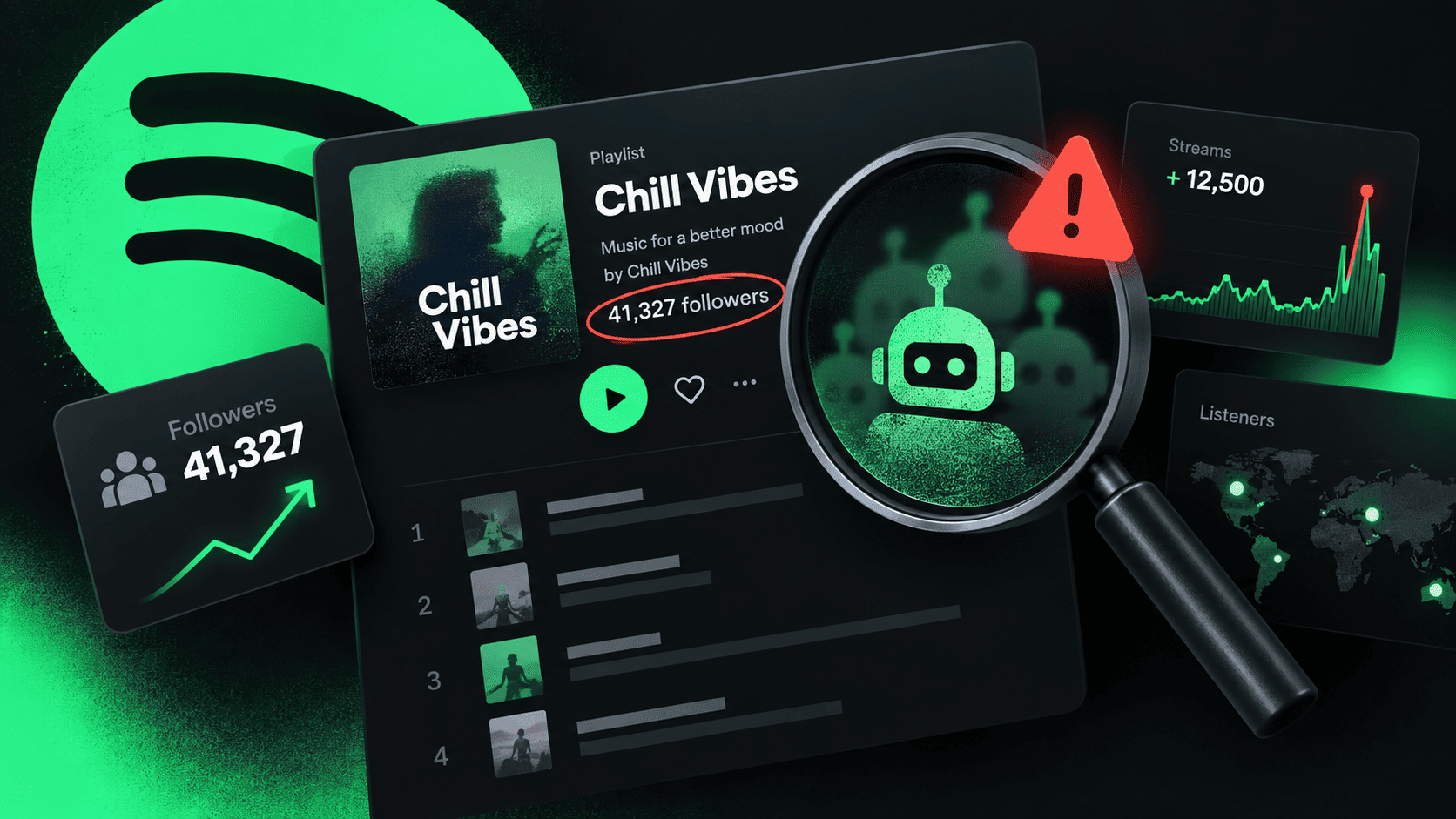
If you are trying to figure out whether a Spotify playlist is fake, botted, or artificially inflated, look for a pattern rather than one magic metric. Guaranteed streams, unexplained growth, strange listening locations, weak listener behavior, an untraceable curator, and a tracklist that makes no musical sense become much more meaningful when several of them appear together.
The important part is this: you usually cannot prove from public data alone that a playlist uses bots. Spotify has access to listening behavior that artists, playlist-analysis tools, and outside observers do not. What you can do is identify risk before paying for promotion and recognize suspicious activity quickly if your song has already been added.
Last reviewed: September 30, 2026.
The short answer: how can you tell if a Spotify playlist is fake?
Start with the offer, then inspect the playlist, and finally check what happens in your Spotify for Artists data. A playlist deserves extra scrutiny when the curator guarantees streams or placement, its audience growth looks difficult to explain, its track selection feels more like a list of paying customers than actual curation, or a placement creates a sudden burst of streams without corresponding signs of real listener interest.
Spotify itself lists sudden unexplained stream spikes, unusual listening locations, surprising sources of streams, and short-lived follower growth among the signals artists should investigate. Spotify also says that services promising guaranteed streams or guaranteed paid playlist placement are not legitimate.
If you only remember one rule, make it this one: do not judge a playlist by its follower count. Judge the story behind the number.
Fake Spotify playlist checklist
| Check | What to look for | How seriously to take it |
|---|---|---|
| Guaranteed placement or streams | A curator or promotion service promises a fixed placement, stream count, or algorithm boost for payment | Major red flag |
| Follower growth | Large unexplained jumps, repeated spikes, or growth that does not match any visible event | Strong supporting signal |
| Curator identity | No clear person, company, website, social presence, or explanation of how the playlist is built | Supporting signal, not proof |
| Track selection | Songs appear unrelated in genre, mood, audience, or purpose | Supporting signal |
| Playlist network | One account operates many nearly identical large playlists with similar descriptions and rotation patterns | Worth investigating |
| Post-placement stream behavior | A sharp spike arrives and disappears without saves, followers, repeat listening, or other fan activity moving with it | Strong supporting signal |
| Listener geography | A large new audience suddenly appears in countries or cities where the artist has no known activity | Strong when unexplained |
| Source of streams | A surprising concentration appears in a source that does not match the campaign you actually ran | Strong when combined with other anomalies |
| Transparency | The promoter cannot explain how listeners are acquired or refuses to provide campaign details | Major business-risk signal |
No single row in this table proves botting. That is deliberate. A real playlist can grow suddenly after a viral post. A curator may prefer to stay private. A niche playlist can have a strange-looking track mix. What becomes concerning is the combination.
First, be clear about what “fake playlist” actually means
People use the phrase loosely. One person means a playlist with purchased followers. Another means a real playlist whose streams are being artificially generated. Someone else may call any paid playlist fake, even when the playlist has genuine listeners.
Those are different situations.
Spotify defines artificial streaming as streaming that does not reflect genuine user listening intent, including attempts to manipulate the service through automated processes such as bots or scripts. Its user guidelines also prohibit artificially increasing play counts or follow counts and prohibit accepting compensation to influence playlist content.
You can read Spotify's current explanation of artificial streaming and its User Guidelines directly.
For an artist, the practical question is therefore slightly different from “Can I prove this playlist is fake?” What you really need to know is: Does this playlist show enough risk that I should avoid it, stop working with the promoter, or investigate the streams it is sending me?
That question is much easier to answer.
1. Start with the pitch before you analyze the playlist
A surprising amount of playlist due diligence can be done before opening Spotify.
Suppose somebody messages you with an offer like this: $80, 30-day placement, 15,000 guaranteed streams. At that point you do not need an elaborate bot-detection formula. The guarantee itself is the problem.
Spotify says third-party services that guarantee streams are not legitimate. It also states that services guaranteeing playlist placement in exchange for money violate its terms. That makes a guaranteed outcome much more useful as a warning sign than whether a playlist has a generic cover image or 27,000 followers.
Be careful with the wording, too. “Guaranteed exposure,” “minimum reach,” “algorithm activation,” and “we make sure Spotify pushes your song after placement” can be dressed-up versions of the same promise.
A legitimate marketer can promise work: outreach, advertising, research, campaign management, submissions, creative production, or reporting. They cannot honestly promise how thousands of independent listeners will behave.
JamFeed covers this distinction in more detail in our music promotion guide for independent artists.
2. Look at the curator, not just the playlist
Click the account that created the playlist. Spend a minute there.
You are not looking for a blue checkmark or a famous company. Plenty of legitimate playlists are run by ordinary music fans. What you want is a believable reason for the playlist to exist.
Does the curator specialize in a genre? Do the other playlists follow recognizable themes? Is there a description? Has the person built anything elsewhere: an Instagram account, radio show, blog, label, community, DJ profile, submission page, or website?
An anonymous profile is not automatically fraudulent. That would be much too simple. But anonymity matters more when it is paired with an aggressive sales message, enormous playlist numbers, guaranteed results, and no explanation of how the audience was built.
Think of identity as one piece of context. A real-world footprint does not prove a playlist is clean, and the absence of one does not prove it is fake. It just changes how much evidence you have.
3. Ask whether the playlist makes sense for a listener
This is one of the most underrated checks because people tend to jump straight into analytics tools.
Actually look at the songs.
If the playlist says “Late Night Indie” and the music sounds like something a person might genuinely put on for two hours at night, that is coherent. If it jumps from underground techno to acoustic folk, regional rap, meditation music, metal, and a string of unrelated independent releases, ask why.
There can be good reasons. A broad discovery playlist can intentionally mix genres. A publication may maintain a playlist of artists it has recently covered. A music conference might collect performers from completely different scenes.
But there should be some organizing idea that a listener can understand.
A playlist built mainly around whoever bought this week's placement often feels different. The title promises one thing while the tracklist does another. Songs rotate constantly. The artist names change, but the lack of connection between them stays the same.
A simple question helps: If nobody were paying to be added, would a real listener still have a reason to follow this playlist?
4. Do not let a huge follower number do all the thinking for you
Follower count is useful information. It is not evidence of active listening.
A playlist can keep followers who no longer use it. It can have grown during an earlier trend. It can have been promoted heavily with ads. It can also have artificial followers. Looking at the current total does not tell you which explanation is correct.
This is where some fake-playlist advice goes too far. You may see claims that a certain follower-to-track ratio, curator-follower ratio, or fixed engagement percentage proves a playlist is botted. There is no public Spotify rule that gives artists a universal threshold like that.
Treat ratios as prompts for another question, not verdicts.
If a playlist has 70,000 followers, ask how it got them. Search for the playlist name. Look at its history if you have access to a playlist analytics service. Check whether the curator has an audience elsewhere. See if the playlist is regularly updated and whether people appear to discuss or share it.
You are trying to reconstruct a plausible growth story.
5. Check the playlist's growth history when you can
A historical graph is more informative than today's follower total because it adds time.
If third-party analytics show a playlist moving from 2,000 followers to 22,000 almost instantly and there is no obvious event behind the jump, that deserves investigation. Repeated jump-flat-jump patterns deserve even more.
Still, do not make the opposite mistake and assume every sharp rise is fake. Real attention can arrive quickly. A viral TikTok, press mention, creator recommendation, prominent artist share, advertising campaign, or outside feature can cause unusual growth.
The right question is not “Did it spike?” It is “Can I find a reasonable explanation for the spike, and does the rest of the evidence fit that explanation?”
Also remember that third-party playlist tools are estimating risk from data available to them. They do not have Spotify's complete fraud-detection data. A bot score can help you prioritize what to inspect, but it should not become a substitute for inspection.
6. Watch for playlist factories
One big playlist does not necessarily look strange. Ten of them sometimes do.
Open the curator's full profile. If you see a collection of similarly named playlists — “Viral Pop 2026,” “Best Rap 2026,” “Top Indie 2026,” “Viral EDM 2026,” “Top Rock 2026” — each carrying a surprisingly large audience, look closer.
Again, scale itself is not evidence of wrongdoing. Real media brands and playlist companies operate networks.
What matters is whether the network behaves like an editorial product or like inventory. Do the playlists have distinct audiences and identities? Are descriptions specific? Is the music actually curated to the stated theme? Is there a visible business behind the account? Can the operator explain how people discover the playlists?
If the answer to every question is vague while the sales page is extremely precise about prices and guaranteed numbers, you have learned something useful.
7. After placement, your own Spotify for Artists data becomes more valuable than public clues
Before your track is added, you mostly have circumstantial evidence. After it is added, you can compare the placement with actual changes in your artist data.
This is where the investigation gets much stronger.
Spotify for Artists lets you examine where streams come from and filter data by metrics such as streams, listeners, and streams per listener. Spotify separates sources into active listening — where someone intentionally seeks your music out — and programmed listening, which includes playlists created by other listeners as well as Spotify-programmed sources.
Spotify explains the current categories in its Source of Streams documentation.
Write down your baseline before a promotion starts. Then compare the days during and after the placement.
You are looking for a story that makes sense. A real playlist placement may primarily create programmed streams at first. That is normal. But some of those listeners may also save the track, follow the artist, add the song to their own playlists, return later, or explore other music.
If thousands of new plays appear and almost nothing else in your artist picture changes, that does not automatically prove bots. It does tell you the promotion deserves a closer look.
8. Take sudden stream spikes seriously, especially when they disappear just as fast
A good playlist can absolutely create a spike. That is part of the point of being playlisted.
The shape becomes more interesting when the increase has no known cause and collapses immediately afterward.
Spotify specifically tells artists to watch for a sudden spike in streams with no apparent explanation followed by a drop. That is one of the platform's own examples of abnormal activity associated with artificial streaming.
Context is everything. If you were added to a legitimate high-reach playlist on Tuesday, a Tuesday spike is not mysterious. If a promoter claimed to be running Instagram ads in the United States but your streams suddenly multiplied overnight from a playlist you have never heard of, there is a missing piece in the campaign story.
That missing piece is what you investigate.
9. Check where the new listeners came from
Geography can be surprisingly revealing when you already know your audience.
Imagine an artist whose audience is normally concentrated in Chicago, New York, Toronto, and London. A campaign starts, and two days later a city the team has never targeted becomes the artist's largest listening location by a huge margin.
That is worth asking about.
Spotify itself names an unexplained spike in streams from locations where the track was not previously active as a possible artificial-streaming signal.
But “unexpected country = bots” is bad analysis. Music crosses borders every day. An influencer can use a song. A local playlist can pick it up. A fan community can suddenly discover an artist. Genres also travel in ways that surprise artists who only look at their social followers.
So check your other campaign activity. Did a Reel take off there? Did a local creator share the song? Is the playlist itself focused on that market? Is there press coverage you missed?
Unexpected geography with an explanation is interesting. Unexpected geography with no explanation, no related fan activity, and other suspicious signals is different.
10. Compare streams with what real people tend to do next
A stream is an event. A fan is a relationship. Those should not be confused.
Real listeners do not all behave the same way, and most people who hear a song will not follow the artist or save it. Still, genuine discovery produces variation. Some people skip. Some replay. Some save the song. A smaller group visits the profile, listens to another track, follows the artist, or adds the song to a personal playlist.
This is why one isolated stream total tells you so little.
Compare the placement period with:
- listeners and streams per listener;
- saves;
- personal playlist adds;
- artist followers;
- active audience changes;
- catalog listening beyond the promoted track;
- countries and cities;
- the source-of-streams mix;
- any traffic or fan activity you can independently connect to the campaign.
Do not invent a universal save-rate cutoff and call everything below it fraudulent. Different genres, playlist types, listener situations, and stages of an artist's career produce different behavior. Compare a campaign with your own baseline and with other placements whose traffic you understand.
Signals that are suspicious but do not prove a Spotify playlist is fake
This distinction matters. Artists are often given oversimplified rules online, and some of them create false positives.
A generic playlist name
“Workout Hits,” “Indie Chill,” or “Songs for Driving” may sound generic because millions of real people describe music that way. A keyword-heavy title is worth noticing only when the rest of the profile also looks questionable.
An anonymous curator
Some people simply do not attach their real identity to Spotify. Lack of a photo or Instagram profile lowers transparency; it does not establish artificial streaming.
Lots of unknown artists
A playlist full of small artists can be exactly what a genuine independent curator is trying to build. In fact, discovering artists you have never heard before is one reason playlists exist.
A sudden follower spike
It may be manipulation. It may also be publicity, advertising, a viral moment, or a major share. Find the context before deciding.
A low number of curator followers
People can follow an individual playlist without caring about the curator's profile. A huge mismatch is a reason to ask more questions, but there is no official Spotify ratio that proves fraud.
One unusual country
Unexpected geography becomes useful when it is unexplained and appears alongside other anomalies. By itself, it may simply mean the song traveled.
The 2-minute fake playlist check before you submit a song
- Read the offer. If somebody guarantees streams, paid placement, or an algorithmic result, stop there.
- Open the playlist. Ignore the follower number for a moment and read the title, description, tracklist, and recent additions.
- Open the curator profile. Look at the other playlists and whether a real editorial identity exists behind them.
- Search the playlist and curator name. See whether there is an outside history, community, website, media presence, or discussion around it.
- Look for historical data if available. Unexplained follower jumps or repeated staircase-like growth deserve more investigation.
- Ask how the audience was built. Legitimate operators should be able to explain their promotion method in understandable terms.
- Save the playlist URL and your baseline data. If you do proceed, you will have something to compare later.
That last step takes an extra minute and is the one artists forget. Screenshot or record your current listeners, streams, followers, top countries, top cities, source mix, saves, and playlist activity before a campaign. Without a baseline, a suspicious result becomes harder to reconstruct later.
What should you do if your song is already on a suspicious playlist?
Do not start by accusing the curator publicly. Preserve the information first.
Save the playlist URL, playlist name, owner, date you noticed the placement, your track position, relevant messages or invoices, and the name of any promotion company involved. Take screenshots of the unusual Spotify for Artists activity and record the dates.
Then compare what happened with every legitimate campaign you were running at the same time. You want to be able to explain what you paid for, what channels were used, and which activity you can account for.
If you hired a promotion provider, ask for a written explanation of where the listening came from. If you believe artificial streaming may be involved, stop additional activity while you investigate.
Spotify advises artists who notice abnormal activity to contact their label or distributor and share details of services used to promote the music. Spotify also provides a way to report suspicious playlists so its team can investigate them.
Most importantly, keep the evidence. “My streams looked weird” is hard for a distributor to investigate. Dates, playlist URLs, campaign records, messages, locations, source changes, and screenshots are much more useful.
Can a fake playlist hurt your Spotify account?
Potentially, yes, particularly when artificial streaming is involved.
Spotify says confirmed artificial streams do not earn royalties, do not count toward public stream numbers or charts, and do not positively influence its recommendation algorithms. Depending on the severity, additional consequences can include removal from Spotify playlists. Spotify also says distributors may issue warnings, charge penalties, suspend accounts, or remove music after receiving artificial-streaming reports.
That does not mean an artist is automatically guilty because an unknown playlist added their song. Spotify explicitly acknowledges that some artists can be hit with artificial streaming without requesting it.
That distinction is important. If you discover suspicious activity you did not cause, documenting it and contacting the appropriate distributor or platform channel is more useful than ignoring it.
Is paying for Spotify playlist promotion always fake?
No, but you need to know what you are actually paying for.
There is a difference between paying a marketing company for legitimate work and paying for a guaranteed Spotify outcome.
A company can charge for campaign management, advertising, research, outreach, creative production, or access to a submission process. Spotify itself notes that some services charge artists to be considered for user playlists without guaranteeing placement, although Spotify advises artists to be highly skeptical and carefully research how such services operate.
The line becomes much clearer when money buys a guaranteed playlist add or guaranteed streams.
Ask the provider one plain question before paying: What exactly are you selling me that you directly control?
If the answer is outreach, ads, staff time, research, or submissions, you can evaluate the work. If the answer is “20,000 streams,” the product is the number.
What a healthy playlist placement should give you
A legitimate playlist does not have to turn every listener into a fan. Most won't become one. It also does not need to create a huge number of streams to be useful.
What you want is credible discovery.
The placement should make sense for the song. The playlist should make sense for its listeners. The curator should be able to explain what they do. And when people encounter your music, at least some of the wider behavior should look like people rather than units being delivered to an order.
That can mean saves. It can mean repeat listening. It can mean a few new followers, personal playlist adds, profile activity, or people exploring another song. Sometimes the biggest benefit is simply putting a good release in front of the right small audience.
Ten thousand streams that teach you nothing about your listeners are less useful than 800 streams that introduce 40 people who come back for the next release.
If you are building a broader release campaign rather than chasing one playlist number, JamFeed's Music Release Campaign Planner can help organize the work before and after release day.
How JamFeed built this checklist
For this guide, JamFeed reviewed Spotify's current documentation covering artificial streaming, paid third-party services, user guidelines, source-of-streams reporting, playlist data, and the signals Spotify tells artists to investigate.
We also reviewed the playlist-vetting methods commonly used across current music-marketing and playlist-analysis resources. Where those methods go beyond Spotify's published guidance — follower ratios are a good example — we treat them as heuristics rather than facts.
That separation matters. Nobody outside Spotify can see every signal Spotify uses to identify artificial listening. A third-party checker can flag an unusual pattern, and an experienced marketer can identify a risky promotion offer, but neither should claim certainty from one public number.
The goal of this checklist is therefore not to label playlists from a distance. It is to help artists make better decisions with the evidence they actually have.
Frequently asked questions
How do you know if a Spotify playlist has fake followers?
You usually cannot prove fake followers from the public follower count alone. Check the playlist's historical growth if available, the curator's broader profile, outside audience, track selection, and whether follower changes have a believable explanation. Sudden unexplained jumps become more meaningful when they appear alongside other suspicious signals.
How do I know if a Spotify playlist uses bots?
Look for a combination of evidence: guaranteed streams or paid placement, unexplained listener spikes, strange geographic changes, surprising sources of streams, short-lived follower growth, opaque promotion methods, and little meaningful listener behavior after the spike. Spotify for Artists data is especially useful once your music has been added.
What is the biggest red flag for a fake Spotify playlist?
Before placement, one of the clearest warning signs is somebody offering a guaranteed number of Spotify streams or guaranteed playlist placement in exchange for money. Spotify explicitly warns against both. After placement, unexplained abnormal listening patterns provide additional evidence to investigate.
Can a Spotify playlist have fake followers but real listeners?
It is possible for different forms of manipulation and genuine activity to coexist. A playlist might have an inflated follower count while still attracting some real listeners through search, social media, or advertising. That is another reason a single metric cannot establish whether all activity from a playlist is artificial.
Can I check a Spotify playlist for bots for free?
You can perform much of the first-pass check without paying for a tool. Inspect the playlist, curator, track selection, other playlists, web presence, and promotion offer. Historical follower data and additional estimates may require third-party analytics, but those tools should be treated as risk indicators rather than definitive proof.
Are all paid Spotify playlists fake?
No. The important distinction is what the payment buys. Paying a company for legitimate marketing work or a disclosed submission process is different from buying guaranteed playlist placement or a fixed number of streams. Spotify says services guaranteeing placement in exchange for money violate its terms and advises artists to be highly skeptical of paid playlist-submission services.
What should I do if a suspicious playlist adds my song without permission?
Document the playlist and the unusual activity, review your Spotify for Artists data, and contact your distributor or label if artificial streaming may be involved. Spotify states that artists can also report suspicious playlists directly for investigation. Do not assume an unsolicited placement means you caused the activity.
Can fake Spotify streams affect royalties?
Yes. Spotify says artificial streams it identifies do not earn royalties. Confirmed artificial streams are also excluded from public counts and charts and do not positively influence recommendation algorithms.
Bottom line
The easiest fake playlists to avoid are the ones that tell you what they are before the campaign begins: guaranteed placement, guaranteed streams, mysterious “algorithm boosts,” and a seller who can describe the result in detail but cannot explain where the listeners come from.
The harder cases require context. Check the curator. Check the playlist's purpose. Look at growth over time instead of one impressive number. Then, if your track is added, use Spotify for Artists to see what actually changed.
And resist the temptation to turn one ratio into a fraud detector. Real audiences are messy. They grow at different speeds, live in unexpected places, skip songs, save some tracks and ignore others. That messiness is part of what makes real listening look real.
A fake playlist checklist is useful precisely because no single checkbox is enough.